Some family lines resemble a skinny tree while others have a tangled web of branches that sprout off in all directions. The theme for Week 5 of 52 Ancestors is “Branching Out” and my family line of the week is the Drogowski Family. My mother’s mother’s mother’s mother was a Drogowski, and I have far more DNA matches from her parents than any other set of 3rd great grandparents.
The patriarch of this family is my 5th great-grandfather, Grzegorz Drogowski, who was born about 1741 in Wilczyn to Bartołomej Drogowski and Justyna Smyk. Around 1770, Grzegorz married Rozalia Szternalska. The couple had three children: a son, Wojciech, who was born in 1773, and two daughters, Maryanna and Francizka, whose birth dates are unknown.
In March, 1824, Rozalia died at the age of 80. Shortly afterwards, 83-year-old Grzegorz marries again. His bride was the 30-year-old Maryanna Stawska. A son was born in 1825, Kajetan, and another in 1827, Michal. Also in 1827, Grzegorz died at the age of 86.
Because the children of Grzegorz were born 50+ years apart, young Kajetan and Michal were younger than most of the nieces and nephews from their half-brother Wojciech. Wojciech (my 4th great grandfather) had two daughters (Maryanna and Franziska) and four sons – the daughters and at least two of the sons (Jan and Ignacy) survived infancy. Michal died at the age of 18, but Kajetan married and had at least one son (Stanisław) and one daughter (Eleonora).
From these lines come dozens of families! The branches are too numerous to map out, for it would not fit on this page. Instead I’ll try to summarize some of the interesting things I’ve learned while researching this family.
I’ve written before about Jan Drogowski, my 3rd great-grandfather, who was a linen merchant and occasional smuggler with his “uncle” Kajetan. The two men married sisters, the daughters of Józef Kubinski and Apolonia Lewandowska. Jan’s wife was Konstancja, born in 1818, and Kajetan’s was Nepomucena, born in 1825.
In addition to the double cousins produced from these two marriages, there are three instances of cousin-marriages:
First cousins Franciszek (son of Jan) and Aleksander (son of Ignacy) also married sisters, Teofilia and Wacława Wapinarska.
A grandson of Jan, Kazimierz (son of Józef), married the granddaughter of Ignacy, Kazimiera aka Elsie (daughter of Aleksander) – they are second cousins.
Another grandson of Jan, Stanisław (son of Józef), married the granddaughter of Kajetan, Kazimiera (daughter of Stanisław) – they are second cousins once removed.
As you can tell from the names in the above example, there are many repetitions among the names of these families. There are multiple examples of Józef/Joseph, Stanisław, Franciszek/Frank, and Edward.
The family has two priests (who are second cousins to each other) and three doctors. One of the priests, Fr. Anthony Drogowski, was the officiating minister at the marriage of my best friend’s grandparents!
Several of Jan’s children immigrated, but there is evidence that they journeyed back and forth to Poland. In the case of his son Jozef, several of Jozef’s sons immigrated, but one went back to Poland permanently and one never came. So although Jozef (senior) is buried in Pennsylvania, we have cousins from his other sons still living in Poland.
The family has various settlement points in the United States including Detroit, Pittsburgh, Niagara Falls, Philadelphia, and “upstate” Pennsylvania.
In my research I accidentally discovered a NPE – non-paternal-event. I had a DNA match who shared all of the Drogowski matches, but the individual did not have any Drogowski family. After researching the person’s family, I realized they were from a different part of Poland. I was given access to the person’s DNA matches and immediately saw a first cousin match to one of the Drogowski lines. Unfortunately the person’s biological father was one of the men in this particular branch.
Perhaps the biggest question of all is – was Gregorz really a father in his 80s? It’s possible. Or perhaps he married a pregnant girl to give her child a name. Can we definitively conclude he was the father of Kajetan? Not via autosomal DNA because Kajetan and his “nephew” Jan married sisters. But, perhaps through Y-DNA testing this can be proven. There are male descendants from both Kajetan and Jan. The only thing that would negate the testing is if Gregorz married her because his married son Wojciech had gotten her pregnant.
This post is dedicated to the memory of my 4th cousin, Paweł Drogowski, who died unexpectedly last August at the age of 40. Paweł and I attempted to create a complete genealogy of all of the Drogowski branches and the various other surnames that connect to the family from its female descendants. May he rest in peace.
Research is formalized curiosity. It is poking and prying with a purpose. ~ Zora Neale Hurston
The genesis of a family historian is curiosity. I’ve discovered that people are either interested in knowing about their family’s past, or they really don’t care at all; there is no in-between. The Week 4 prompt for 52 Ancestors is “Curious.” I have no idea which of my ancestors had a curious personality, so rather than focus on a particular ancestor I’m looking in the mirror – what am I still curious about after over 30 years of researching my family’s history? Plenty! As I discover new information, my questions seem to multiply. So what’s a curious genealogist to do? Formalize that curiosity by developing research plans to poke and pry and, hopefully, quench that curiosity! Here’s a few things that I’m still curious about…
Double Life
Why does my great-grandfather Joseph Zawodny have two different social security numbers? I discovered this just last week! In one of the social security databases, his name is listed with the same birth date and parents’ names, but different numbers. I already have his SS-5 card – or I should now say one of his SS-5 cards – and that number matches the one on his death certificate. Now I’m really curious about the other one…did he forget he already applied? Or is there something to that lingering story that he used someone else’s name?
Research Plan:Order the SS-5 card. Do I need the information? Given that I already have his birth, death, and marriage records as well as those of his parents and great-grandparents – no, not really. But I’ll spend the $21 because I am curious! [See this post from The Legal Genealogist if you don’t know what a SS-5 card is or what it will reveal.]
The Missing Sister…
What happened to my grandaunt, Jean Piontkowska Hynes? So far I’ve tracked her and her husband, William R. Hynes, from New York City to Florida where they resided in 1940. In October, 1944, according to The Tampa Tribune, William filed for divorce. However I found no record of the divorce and no notice of it in the paper. William married again in the late 1940s (his third marriage). On Jean’s brother’s obituary in 1953, she is listed as living in Detroit, but obituaries are not that reliable and I haven’t found any other evidence of that. According to William’s child from the post-Jean marriage, Jean might have been living in New York City around 1958 and when she became ill and her ex-husband helped her out. Where and when did she die?
Research Plan: I’m waiting for the release of the 1950 census to determine where Jean went after leaving Florida (if she left); then continue to search for her death record. I still don’t actually have her marriage record to William from around 1926; one story says they never actually were married, but William would know that so why would he file for divorce if they weren’t actually married? I’d like to find that divorce record, too, so I’ll check with the county clerk for Pinellas County.
Across the Pond
What happened to the rest of the Pater family that remained in Poland? I already know that my great-grandfather’s first cousin, Józef Pater, a decorated war veteran, was active in the Polish resistance during WW2. This resulted in his fourteen month-long imprisonment in Pawiak Prison, shipment to Auschwitz, and his death there eight weeks later. His wife, Helena Palige Pater, was also imprisoned at Pawiak for the same amount of time and died at Ravensbruck. Either his son or his brother, both named Bronislaw Pater, died at Majdanek. Jozef was the son of Marcin Pater, my great-great grandfather’s brother. Another brother was named Stanislaw, and both had children. When I visited the Pawiak Museum in Warsaw in 2017, I saw a photo on the wall of a Stanislaw Pater that seemed to resemble Jozef. I’m curious if it was his brother or uncle, and I wonder what happened to the rest of the Pater family.
Research Plan: Write to the Pawiak museum requesting information on Stanislaw Pater, check Arolsen Archives that document Nazi persecution, continue to look at several research sites that contain Polish vital records, and search family history sites for relatives.
Exiled
What happened to the Miller brothers who were exiled to Siberia? Last week I wrote about my 2nd great-grandmother, Elizabeth Miller. Her daughter Zofie told her nieces that her brother Emil Pater was exiled to Siberia. This occurred either during World War I or the Polish-Soviet War that immediately followed it.
Research Plan: Find some books that detail this event, especially the Polish-Soviet War which isn’t as well known in the U.S. I could also attempt to find descendants of Emil’s daughter, Wanda, who remained in Poland after her mother returned to the U.S. in 1930 (assuming her family survived WW2).
Who’s the Daddy?
When you have DNA matches that are close enough to figure out and both people have done extensive family research but the trees do not match, you know there’s a paternity that doesn’t match the paper trail. Such is the case on my Zawodny line (actually my Ratajczyk line as my 2nd great grandfather adopted the use of the name Zawodny from his stepfather). Because I have three matches all descending from the same ancestor, I suspect he is actually my 3rd grandfather. He and my 3rd grandmother were in the same general vicinity, but not in the same town. However, no other explanation makes sense as to how I keep matching to his descendants.
Research Plan: How to determine this? Y-DNA would be useful, but my matches aren’t from the direct male line of this ancestor. I need to dig more into their family line to find a direct male line to prove my theory.
When I use prompts or themes to write with challenges such as “52 Ancestors in 52 Weeks” or the much loved but long-gone “Carnival of Genealogy,” usually I either read the theme and know immediately who or what I will write about, or it takes a great deal of thought to come up with something. This week, for Week 3 of the 2022 “52 Ancestors” theme of “Favorite Photo,” I discovered a third option: I knew exactly which photo I wanted to write about, but then it was as if another ancestor was like a child raising her hand and yelling, “Me! Me! Pick me!” When your great-great-grandmother metaphorically speaks to you, listen – as it turns out, I had already written about my “other” favorite photo in 2015, and my 2nd great grandmother’s life was quite extraordinary in simple ways. Her name was Elizabeth Smetana Miller. Her ancestors were “pioneers” of sorts, fleeing religious persecution and settling – even founding towns – in a foreign land. In her youth, her family and several others moved 90 miles away from their birthplace in search of better things. Later, as a mother, her children began to migrate even further away to the United States. I have a documented oral history from a cousin that tells even more of her story: she cared for her younger children plus five grandchildren for over a year. Then, after seeing her grandchildren and one son off to America, she faced widowhood and a world war on their doorstep. Surviving the war years, she would make one more journey – this time to America herself – where she lived another quarter century as the family matriarch in Metuchen, New Jersey. The few facts and stories tell me she was one tough cookie!
Here is my favorite photograph of Elizabeth Smetana Miller. It was taken on Long Island, NY in 1925 and she is holding her great-granddaughter Lucille. Besides wanting to tell Elizabeth’s story, I chose this as my current “favorite” photo for several reasons. I was able to see and photograph it in the summer of 2014, but I had only learned the previous year that Elizabeth immigrated to the United States. I had assumed she died in Poland and was quite excited to discover otherwise. Finding the cousin that had the photos and stories – as well as finding out about Elizabeth’s long life – was a mix of genuine research and serendipitous good luck!
Elizabeth Smetana Miller (age 67) and her great-granddaughter in 1925
Elizabeth Smetana was born on 06 April 1858 in Zelów, a town that is in Poland today. Then Poland did not exist as a country, and this area was under Russian rule. Her family, and most of the town of Zelów, had lived in the area that is now Poland for over a century, but they were ethnically Czechs from Bohemia. Her name in Czech is Alžběta Smetanová; in Polish it is Elżbieta Smietana.
She was the fifth child born to Pavel Samuel Smetana and Anna Karolina Jelinek (Jelínková). Pavel’s ancestry will be discussed later this year for another theme of “52 Ancestors” – for now let’s just say there are some questions about his parentage. But Anna’s ancestors are among the “founding fathers” of Zelów and some of the other Protestant Czech settlements that proceeded it as they were fleeing religious persecution in their homeland (read about one of her ancestors here). Both sets of Anna’s grandparents, Jan Jelinek-Maria Pospischil (Pospíšilová) and Jan Jirsak-Anna Nemecova, moved to the town within the first few years of its founding in 1802.
Zelów was founded as a farming community, but as the town grew, residents who were not landowners became weavers. Their skills led them to migrate to two larger cities that had a need for skilled textile workers: Łódź and Żyrardów. During Elizabeth’s childhood, approximately in the 1870s, at least eight Zelów families moved to Żyrardów for these opportunities.
In addition to the Smetana family, the family of Matej and Marie (Szara) Miller were among those who moved. The Miller family had a son, Jan, who was born in Zelów on 24 November 1849. He was almost a decade older than Elizabeth, but the pair were married by 1880.
Elizabeth and Jan Miller had eight children:
Emil born on 22 December 1881
Marya (Mary) born on 24 March 1884
Karolina born on 12 March 1886
Elizabeth born on 19 November 1890 (my great-grandmother)
Paweł born on 11 December 1893
Alfred born on 18 April 1896
Zofie born on 03 April 1903
Their oldest son, Emil, was the first to emigrate to America in 1904, followed by his wife and daughter. Jan and Elizabeth’s daughter Elizabeth followed in 1909. In 1912, Mary, now the wife of Ludwik Szulc (Shultz), followed her husband. At the time, the Shultz’s had five children, but Mary left the children – temporarily – with her parents, Jan and Elizabeth. It is through Mary’s oldest daughter, Louise, that I know about their living arrangement. Louise was born in 1903 and was only a girl of nine when her parents left for the U.S. For a year Louise lived with her siblings, grandparents, uncles and one aunt who was the same age as her. Decades later, Louise told her story to the Ellis Island Oral History Project. [The entire story of Louise Schultz and her family is told in a 3-part series of posts beginning with Life in Poland and the Decision to Leave (Part 1); I repeat a few snippets here.]
Elizabeth was now responsible for her own four children still at home – ages 19, 16, 12, and 9, as well as her daughter Mary’s five children – ages 9, 8, 6, 4, and 3. In addition to the added responsibility of caring for five young grandchildren, Elizabeth was the sole supporter of the family because her husband Jan was sick.
Jan and Elizabeth Miller in 1913 with four of their children and the Schultz grandchildren. Left: Ludwik Miller, Zofia Miller, Elzbieta Miller, Louise (Ludwika) Schultz, Alfred Miller, girl in front – Julia Schultz, Jan Miller, Pawel Miller, Henry Schultz, Edward Schultz.
Louise, like most 9-year-olds, thought her grandmother “was old, but actually she was not.” [Note: her grandmother was 55 years old at the time.] Louise explains, “My grandfather was sick; he was in bed. She was very fast, my grandmother. She worked the looms, one on one side and one on the other so she could make enough money.”
Finally, on 06 August 1913, Mary and Ludwig Schultz sent enough money for their children to immigrate, accompanied by their uncle Alfred Miller. Just three weeks later, Jan Miller passed away on 25 August, leaving Elizabeth a widow with three children still at home: Paweł, Ludwik, and Zofie. Perhaps she had hopes of joining her adult children in America, but those hopes were dashed by the “Great War.”
When the war began, Żyrardów was on the front line. Hundreds of workers were drafted into the army. Because of the decrease in workers and the lack of raw materials, the factory began to reduce production. Food prices increased. As German troops made their way through Russian Poland, martial law was declared.
In early 1915, goods, raw materials, and machines were removed from the textile factory. The town was deserted due to forced digging of trenches, general displacement, and epidemics of infectious diseases. The worst came after the collapse of the front line of Płock-Bzura-Rawka. On the night of July 16, 1915, the retreating Russian army blew up the main factory buildings. By the end of 1915, the town was under German occupation. During that time, charity committees were abolished and strict food regulation was imposed.
In an article in The New York Times on October 26, 1915 (originally printed in The Chicago Tribune on September 24), reporter James O’Donnell Bennett writes about crossing “Russian Poland” which at that time in the war was in German or Austrian control. He writes:
Often in the last five days I have made the experiment of looking out over the wide landscape to see if I could find an unscathed tract of country. Always the experiment is a failure. Always a shattered church tower notches itself against the sky or a battered village lies crumpled at the edge of fields.
The reporter mentions several towns his party traveled through, including Żyrardów. He describes the whole country as
…flyblown and sodden and a ‘nobody cares’ atmosphere envelops it…It is all waste and wreckage, wreckage and waste, a land of grime and ruin and sour smells, of silent fields and slatternly women, of weary sentries…
Louise said her aunt eventually told her what it was like during the war and “how awful it was when the German army went through the town.” Louise realized that she and her siblings “just missed the horror of a war. They used to hide in cellars and had no food. My grandmother went from one farm to another to beg for a piece of bread.”
It is believed that Elizabeth’s son Paweł was part of the Soviet roundups in Żyrardów that sent residents to Siberia. He did not return from the exile and presumably died there. Elizabeth’s daughter, Karolina Miller Razer, may have suffered the same fate; her sister Zofie later told her niece Louise that Karolina died “in prison”.
Ludwik Miller, a young teenager, either joined or was conscripted into the Russian Army sometime during the Great War. He survived the experience and lived a long life. [Although he visited the United States, he never immigrated and remained in Żyrardów.]
The oldest son, Emil Miller, who was the first of the family to immigrate to America, actually returned to Poland in 1913 after the death of his father. He brought his wife and their children, two of whom were born in America, but after the war began there was no way to leave. Emil and one of his daughters died in Poland during the war. Emil’s wife, Zofja, and American-born son Edward could finally return to America in 1927 (Edward) and 1929 (Zofja). Another daughter (Wanda) stayed behind in Żyrardów.
Widowed Elizabeth and her youngest child, Zofie, would eventually immigrate to America themselves. They sailed aboard the Megantic from Liverpool and arrived in Portland, Maine on 10 December 1920. Elizabeth a lived for a time with Alfred in New York, then with Mary in New Jersey.
I’d like to know more about Elizabeth’s life in America, but I only know where she lived and that she died on 08 November 1944 at the age of 86 (even though her obituary says 81 – I have her birth record!) Thanks to other snippets of her life gleaned through her granddaughter Louise’s memories, I think she was a brave woman. Like her forefathers before her, she also made trips in her life in search of better things. She worked hard for her family, cared for her husband, and suffered both the separation from her children and grandchildren as well as the deaths of some of her children. She also had to be of strong character to endure the suffering caused by World War 1 from 1914-1918 and continued with the Polish-Soviet War from 1918-1921. She was fortunately to be able to leave the country while it was at war.
Elizabeth was 62 when she arrived in America and she lived for another 24 years. In fact, she had a longer lifespan than her husband, probably all of her children (Ludwik’s death date is unknown, but he was alive in 1977 at age 83), and even longer than the majority of her grandchildren who grew up in relative comfort in America as compared to her life in Poland.
Sources:
Štěříková, Edita: Zelów (Česká exulantská obec v Polsku), published by KALICH, Prague 2002, ISBN 80-7017-793-4
Kopie księg metrykalnych, 1826-1888. Authors: Kościół ewangelicko-reformowany. Parafja Zelów (Łask) (Main Author). Format:Manuscript/Manuscript on Film. Publication: Salt Lake City, Utah: The Genealogical Society of Utah, 1970, 1980, 1990.
Ellis Island Oral History Project. Series AKRF, no. 0033: Interview of Louise Nagy by Dana Gumb, September 16,1985
“Zigzagging Over Poland” by James O’Donnell Bennett, The New York Times, October 26, 1915, page 3.
Finding the photo of my 2nd great-grandmother courtesy of her great-granddaughter, Judy.
The theme for Week 2 of the 2022 edition of “52 Ancestors in 52 Weeks” is “Favorite Find.” I’ve had several favorite finds in the many years of researching my ancestors, and my favorite tends to be the the latest record, fact, photo, or person I found. But I have to admit that this find was rather unique and still makes me smile.
Prussia’s Most Wanted!
When I research my family tree, most of the ancestors are merely names and dates without any stories or context about who they really were as people. But, depending upon the circumstances, or the peripheral information about their occupation or town or family, some ancestors seem to call to me as if they have a story to tell. Jan Drogowski, one of my 3rd great grandfathers, is one of those ancestors. Maybe because he was the son of a farmer who became a linen merchant. Or because he lived during most of the 19th century (from 1818 to 1894). Or because he had ten children and I have dozens DNA matches among his many descendants. But his story got even more interesting with my favorite find.
I wrote about Jan’s life for the 2015 “52 Ancestors” challenge for Week 17 (“Prosper”). I assumed he had prospered since he was the son of a farmer who, at age 20, was already a linen merchant when he married the daughter of a farmer. He also was literate, which was not common at the time. He and his wife Konstancja had ten children together.
Years after I wrote that post, I used a rather unscientific form of research: a quick Google search. I put in just the surname and town name (Wilczyn) and found a reference to Jan on a list in a German newspaper. At first glance, I could tell it provided his physical description, so I was excited about that. I thought it might be a military draft listing. But then it dawned on me — he was from the Russian partition, so why would he be on a draft list for Prussia?
Upon closer inspection and translation, it is a list of people for whom the police have issued warrants! Both he and his uncle Kajetan (who is six years younger than Jan) were seen smuggling merchandise across the border. They were extradited for being “burdensome, troublesome.” My ancestor was a smuggler! Since he was sticking it to both Prussia and Russia who had divided up Poland, I felt proud of that fact.
Wilczyn is circled in red – the dotted line above & to the left represent the border between Prussia and Russia
In 1856, my ancestor Jan Drogowski, age 36, and his uncle Kajetan, age 30, both linen weavers from Wilczyn, are listed in a Prussian newspaper for outstanding warrants from 1855. Jan is described as 5’6” with blond hair, blue eyes, a blond beard, an oval face, a healthy complexion, and medium build. Kajetan is 3 inches shorter with dark hair and no beard.
Jan and his uncle were only six years apart due to a 50-year age difference between Jan’s father, Wojciech, and Wojciech’s half-brother. The pair not only smuggled together, but they must have been close friends since they married sisters.
I guess they never got caught, and now I know how Jan was able to support ten children! His granddaughter (my great-grandmother) lost the blond hair and blue eye connection and had brown hair and eyes.
It’s incredibly rare to obtain a physical description of an ancestor from the early or mid 19th century. It’s also rather rare to get a sense of story or personality from that far back. Usually all we have are names and dates. So I’m very happy with this accidental find. Wilczyn was really right on the very edge of the border between the two countries. I’m sure it was profitable to sell goods on the “other side.” At the time, he had about seven kids. My great grandmother wasn’t born until 1860, so I’m happy he wasn’t caught.
NewspaperSource: Amtsblatt der Königlichen Preußischen Regierung zu Bromberg. Published 1856. Original from the Bavarian State Library, digitized November 3, 2009. Pages 48-49. Accessed via Google Books.
Map Source: Józef Michał Bazewicz, Atlas geograficzny ilustrowany Królestwa Polskiego (Litografia B. A. Bukaty, Warsaw, 1907); digital images, Mapster, http://igrek.amzp.pl/mapindex.php?cat=BAZAKP1907, Powiat słupecki guberni kaliskiej (Note: original has been cropped and edited to highlight Wilczyn.)
This past December as I pondered blogging again, I heard my mother’s voice in my head joking that it took me six months to write a tribute to my father after his death but it’s been over a year since hers – so “what was I waiting for?” (Maybe she’ll be pleased that her tribute is much longer than my father’s!) At the same time, I saw a notice of another “52 Ancestors in 52 Weeks” challenge from Amy Johnson Crow. I participated in 2015’s version and was doing well until May, but I only completed 21 of the 52 weeks. That challenge not only forced me to organize my facts about many of my ancestors and relatives, but it also provided a creative writing challenge to find the right story to fit the prompt.
With these two thoughts in mind, I was happy to see that the Week 1 theme for 2022 is “Foundations” – my mother was the foundation of my life, so how appropriate to start of this new year of blogging with a tribute to her.
My mother died the day I was born; she told me all about it years later. ~ Donna
Left: The Pater Family in 1937 Right: Joan and Anita Pater, circa 1939
Anita Jane Pater was born on December 28, 1935, the second child of Henry and Mae (Zawodny) Pater. Both of her parents were first generation Americans born in Philadelphia to Polish immigrants. Henry and Mae lived a few houses apart on Indiana Avenue in the Port Richmond section of Philadelphia when they married in 1930. Their first child, Joan Delores, was born on August 30, 1932.
By Anita’s own account, her childhood was not happy. Although the sisters were close, they had different personalities and interests and always fought with each other. While Henry earned a good wage at a hosiery factory, he had a habit of losing his paycheck at the racetrack, so the family struggled financially. Many things that Anita wanted, like piano or dance lessons, her parents could not afford. But the things that she loved most about childhood were going to school, going to the movies, and designing dresses.
One of Anita’s first jobs was as an “elevator girl” at Strawbridge & Clothier’s, a large department store at 8th & Market in Philadelphia. The girls operated the large elevators for customers and the minimum age was 18. Anita, 17, lied about her age and got the job. She loved wearing the uniform, and she became friends with three other gals: Ruth, Rita, and Jane. Later she worked in administrative and bookkeeping positions, and years later became a bank teller.
WE’RE FOOLS WHETHER WE DANCE OR NOT, SO WE MIGHT AS WELL DANCE. ~JAPANESE PROVERB
Anita loved to dance! She attended neighborhood dances, mostly held in church and school gyms. Each dance focused on a particular age group from pre-teen to older teens, to almost-adult and beyond. My mother and her girlfriends practiced dancing on the sidewalk in front of their houses.
Dancing played a role in my parents’ marriage – and my existence – because it all started at a dance! On Sunday, March 13, 1955, my mother was 19 years old. She had “outgrown” the fun dances at St. Matt’s, so she and some girlfriends decided to try the Sunday night dance at St. Boniface. It was her first and only visit there.
My father, James Albert Pointkouski, also liked neighborhood dances, and St. Boniface was close to where he lived at the time. The boys danced as a way to meet girls, and they learned by watching others dance. He was 20 years old, lived with his parents, and made $1 per hour hanging garage doors for a company two doors away from his home.
Neither remembers what music was played that night, but a live band performed. When Jim asked Anita to dance, he remembers being glad he had his “little black book” and a pen with him. He asked for her phone number; she gave it to him.
Their first official date was to see a movie (neither remembered which one). Afterward, they went to the Mayfair Diner. During their meal, Jim proclaimed that he really wanted to get married. Surprised that a young guy would want marriage, my mother asked why. “Well,” he said, “it sure would be nice to have someone cook dinner and iron my shirts.” My mother replied, “You don’t need a wife, you need a maid.”
“It’s Cherry Pink and Apple Blossom White when you’re in love” ~ Pérez Prado
Left: Anita and Jimmy dating in 1955 Right: Still dancing in 1992
When Jim asked Anita out again, she wasn’t sure if she wanted to go. She didn’t know what to say, so she pretended she was too sick to go out. That night, he sent her two dozen roses as a get well wish, which made her feel even more guilty about lying. They did go out again, and again, and they were married a little more than one year later on April 7, 1956.
Before their marriage, my father got a job with IBM, and in October, 1956 he had to attend a training class for a few weeks in Endicott, NY. The young newlyweds exchanged letters while they were apart. I’m grateful those letters were saved, because they show how much they loved each other.
March 13, 1955 was the most wonderful day of my life, just as you are the most wonderful person in my life. Jimmy love, I like to think that our love for each other is something special that no one else in this whole entire world could ever possibly share the same feelings. I have given so much of my love to you, that there is only the right amount left over for our children. Leaving very little for anyone or anything else, with the exception of God. I know it’s only because of Him that we have each other.
From Anita to Jim on 10-12-1956
I don’t ever remember anything that ever happened before March 13, 1955. Since then life has had its ups & downs but because of your warmth, companionship & devotion, I’ve never experienced a really sad day – you’ve always been my one lil’ ray of sunshine on which I’ve based all my hopes & plans for the future. …They taught me a long time ago, that the husband is the head of the house but the wife is the heart – and like the body, they must function together to sustain. Baby, that’s how I feel – like half of me is missing. I have your picture, your letters, your phone calls, but I don’t have you.
From Jim to Anita on 10-17-1956 (the day she would die many years later)
Jimmy every night when I go to bed or in work I day dream. I make plans for our future. I think about our children. I can really picture them. They’re adorable. ~ Anita, 10/10/1956
Anita’s babies – whether in 1959. 1967, or 2019
Jim had been in the Navy Reserves since high school, and in February, 1957, he was called to active duty for two years. He spent part of that time at the naval base in Norfolk, VA, and he occasionally could travel home for leave. The couple had their first child, a stillborn daughter, in May, 1958. Anita experienced toxemia with the pregnancy, but they desperately wanted children so she was soon pregnant again. Their son, James Drew, was born in 1959.
At the time of Drew’s birth, the family was renting a house on Knorr Street in the Mayfair section of Philadelphia. In 1960, they purchase a home, or rather a “pile of dirt” as my mother called it, that was still being built. It was on Kirby Drive in the “Far Northeast” part of the city that was still largely undeveloped. They would remain in that house until each had to move into a care facility decades later.
My parents tried to have another child for years, and my mother prayed that she would have a daughter. It took many years before her prayers were answered, and I arrived in 1967. Mom was once again very sick with toxemia, as she was with her other pregnancies. This time, she coded on the table after giving birth to me. Long before anyone wrote about “near death experiences,” she had one. Fortunately for me, it wasn’t her day to die.
A dancer and a lover of musicals!
In the early 1970s, my mother’s love for dancing and my father’s love of making people laugh collided when they became involved with the annual parents’ show at my brother’s high school, Archbishop Ryan. Many of the parents involved in the shows were quite talented, and they performed to a packed house for a weekend every November. Not only did the shows bring great joy to my parents, but they made some life-long friends from this experience.
In the late 70s, two things happened that had a big impact on Anita, and each event is the impetus of the two main areas in which my mother influenced my life: faith and health.
“Christmas was a few short days away. I wasn’t prepared to celebrate this holy day. I wasn’t going to celebrate anything. I was going to die.” ~ Anita, 10/20/1989 about 1983
Anita always believed in God – despite her upbringing. When she was about four years old, her father told her that there was no Santa Claus. Then he told her there was once a God who created the world and everything in it, then He disappeared forever. My mother once wrote about this moment:
I felt such a sense of despair and helplessness. If there was no one to pray to, who could I turn to? Who would listen to my lonely cries? I thought God was supposed to help us – what would happen to me now? I walked out the back door and looked up at the darkening sky and saw one beautiful, shining star just starting to peek through. ‘Twinkle, twinkle, little star, I wish there is a God afar. I don’t care what my father says or thinks, I know you’ll take care of me because without God life stinks.’ I felt better after that. I made my decision that I would believe there is a God even if there wasn’t a Santa Claus.
undated writing by anita
As a child, my mom’s family did not go to church very often, but she was baptized Catholic at the age of three or four (with her older sister), likely at the prompting of her maternal grandfather with whom they lived at the time. My father, on the other hand, had been more of a regular church-goer in his youth. But once they had a family of their own, we only went sporadically despite the fact that my brother and I went to Catholic school.
Around 1977, a friend of my mother’s invited her to a Catholic Charismatic renewal prayer meeting – and it changed her life. She had a reawakening of her faith and rather quickly became more interested in prayer, the Bible, and Mass. I believe that it was her prayers that led my father, my brother, and myself to find our own personal relationships with God. My father and I found our way back to the faith within the next few years, and my parents and I both became active members of Our Lady of Calvary parish. This happened while my brother was in the Marine Corps, and when he returned home, we were a different family. Soon, mostly from our mother’s influence, he also rediscovered the faith.
My mother led many others to Christ with her testimony and was a woman of powerful prayer. Many people have told me that she helped or influenced them. My parents and several of their friends began a weekly rosary group that flourished for years, and she was always willing to pray with others.
Mom’s powerful faith is intertwined in the second way influenced me – how to take care of your body to be healthy. She was definitely a survivor! I already mentioned how she died when I was born, but she came very close to death again in 1978 with an intestinal perforation and peritonitis. She had multiple surgeries and it took her many months to recover, but her faith helped her get through it.
In 1983, she was diagnosed with non-Hodgkin’s lymphoma and began chemotherapy. She felt even more sick from the treatment. But she believed that she would be well. When she refused to have another round of treatments, the doctor told her that she only had six months to live. Through prayer, a positive attitude, and a complete change of her diet and nutrition, the cancer eventually went into remission – and never returned for the rest of her life. It became a pivotal moment in my own life – not just because of how different my life would have been without her, but because I saw the positive – or negative – impact that food, supplements, and even your thoughts could have on your body. I encouraged her to write about her healing about four years later. After describing the stress and fear caused by the diagnosis as well as her physical pain and fatigue, she wrote:
I accepted the bad experience I was going through and believed that good would come from it. One can’t help but marvel at God’s ability to work through us when we encounter a negative experience and make us stronger for it. There is nothing in our lives that God does not allow but it is never His will that we suffer. He allows it so good can come from it. I have found that giving praise and thanks for all things helps you understand how futile stress and worry are and I began to willingly accept trials and tribulations without struggle and more importantly without fear. Negativity is a destructive force that hampers spiritual growth and denies the pleasure of life Being open to God’s will brings us new life and joy. Time on earth is too short to waste.
Anita’s account of her healing from cancer written in 1989
I may be lucky enough to have you for about seventy-five years – all of which would be inestimably happy. ~ Jim to anita, 10/8/1956
Anita was a wonderful cook and loved entertaining friends. She also loved taking day trips to play the penny slot machines at the casinos in Atlantic City. Her other favorite hobbies were watching old movies, especially musicals, and seeing shows downtown.
While she wasn’t as interested in her family’s history as I was, she was fascinated by some of the things I discovered along the way. She told me everything she remembered hearing from her parents, aunts, and uncles, and slowly I took those fragments of memories and found the facts. We even went out for a few meals with cousins she hadn’t seen in decades as well as cousins she’d never even met.
One of her most favorite things was being a grandmother. She became a grandmother for the first time in 1995 with the birth of her first granddaughter, Natalie. Eventually she would have four grandchildren with the addition of Ava in 2005, Nicholas in 2007, and Luke in 2009.
Natalie, Ava, Nicholas, and Luke
Jim developed Parkinson’s that was manageable for over a decade, but in September, 2013, he moved into Wesley Enhanced Living retirement home in Philadelphia. Anita visited almost every day until his death on June 27, 2016. They had been married for sixty years.
I received a beautiful note on the day of her funeral from her parish priest. He wrote that he really got to know my parents due to illness; he used to visit my father in the nursing home and see my mother making her daily visits. He wrote:
I was seeing two people suffering individually and at the same time saw the ways they reached out to each other. They made marriage vows real – ‘I take you for better, for worse, in sickness and in health, I will love and honor you all the days of my life.’ We are blessed being a part of their lives.
Fr. James Kirk, 10/22/2020
In the years after Jim’s death, Anita suffered several transient ischemic attacks (TIAs). She always bounced back and continued to live at home until January of 2020 when she moved into assisted living at Riverview Estates in Riverton, NJ. After March, a difficult period of isolation began due to pandemic restrictions. But she continued to touch people with her faith – several of the caregivers admitted how much they loved conversations with her about faith or praying with her. Anita passed away from a stroke on October 17, 2020.
Anita was a wife, mother, grandmother, and friend. She was a dreamer and a survivor. She was a woman of strong faith. Thank you, Mom, for being the foundation of my life and of my faith – and for teaching me how to love.
The Light
When we remember Who we came from we will know why we are here. When we remember Who the light of the world is, we can let it shine from within. You can be the one who brings someone out of the darkness. You can be the one who shows the way. We need to show the people of this time that God is with us. We need to make them aware of His presence. Do you believe? If so, show others His light. Make a difference! Show them the true light of the world.The light of Jesus. How well do you know Him? How well do you know His word? How willing are you to let His light shine through you?
anita pointkouski 2/7/2014
ETERNAL REST GRANT UNTO HER, O LORD, AND LET PERPETUAL LIGHT SHINE UPON HER. MAY SHE REST IN PEACE. AMEN.
Fourteen years ago I started this blog to pursue my “adventures in genealogy.” But I can’t rightly call this my 14thblogiversary, because I haven’t posted in the last four years. In some ways, those years feel like a very long time, equivalent to the four years I spent in high school. In other ways, it was just yesterday, equivalent to watching my nieces and nephews go from infant to 4-year-old in the blink of a eye.
If you would have asked me this week about that last post, I’d have sworn that I purposely “ended” the blog on its tenth anniversary. But when I read that post today, there are no signs of an end and I was looking forward to the next ten years. Sometime later that month, or maybe later that year, I decided that it stopped being fun. Even though I was far from finished with my family history research, I was content to be finished with blogging about it. I also had other hobbies and responsibilities to fill my time.
Today I find it ironic that the graphic I used for that post four years ago was that of a house’s front door, because all week as I pondered coming back here to write, the image that came to mind was that of an old house. You know, the sort of place you remember like your grandparents’ house that you used to visit, or that favorite aunt’s, or even your own childhood home. Once you return to these places after a long absence, it feels strange – yet so familiar. It feels like home.
I thought I closed the blogging door forever, but apparently the light was left on here and it’s still burning. Like those old houses of our relatives, it’s a bit dusty here and in need of some work. Some things, like links, are broken and need to be fixed. Other things, like information, are outdated, like finding an old phone book in Grandma’s house that still used prefix exchanges. I’m sure there’s a junk drawer where I can still find something useful to help me. I think there is a jigsaw puzzle left on the dining room table with some pieces missing – maybe one of you can help me solve it.
While I throw open some windows to let fresh air in and dust off the furniture, pull up a chair on the porch and have something to drink. I have a few stories left to tell – and they’re all true.
What’s Past is Prologue is ten years old! Or, as my nieces and nephews proudly say when they reach the same milestone – double digits! So how to celebrate a decade of blogging (well, most of a decade…I’ve slacked off in old age)? With a top ten list, of course. I’m often asked to speak in work at retirements, and my comedy of choice is always a top ten. This one is actually serious though, because I really have experienced so many wonderful things as a result of blogging. And so I present…
Top Ten Things I’ve Learned in Ten Years of Blogging
1-Cousins are out there! I come from a “small” family, but other generations weren’t as small as my own. I’ve “found” and met so many cousins as a result of blogging here. Second, third, fourth…even sixth cousins! Cousins from each of my grandparents’ lines, from all over the United States and all over the world. I’ve gotten the opportunity to meet several of my newfound family face to face, and I’ve gotten to know the rest online.
2-Writing is a solo endeavour, but it’s infinitely more fun as part of a blogging community. I began blogging after stumbling upon several other really great genealogy blogs. I didn’t know these people, and we had never met. Yet when I began my own blog, I was welcomed into a community of fellow genea-bloggers. While it began as a virtual community, I’ve been able to meet many at genealogy conferences and become “live” friends. Their humor, talent, and comeraderie means a lot to me!
3-Blogging is like a time capsule, because if you do it long enough you realize just how much has changed since you began. Ten years ago I wouldn’t have imagined using DNA to find cousins and solve mysteries. While some records were online back then (unlike when I first began my research), I wouldn’t have dreamed just how many would become available, including many vital records from Poland online for free
4-Yes, Virginia, other people do actually read your blog. Even the most modest blogger has to get excited to see comments on their blog. People are reading what I wrote! The most gratifying lesson wasn’t necessarily that others were reading what I wrote, but that they were actually helped by what I wrote. I was occasionally able to introduce readers to new resources, and I enjoyed hearing about their success stories via comments.
5-Ask, and you shall receive. Blogging is a great forum for finding solutions to your genealogical problems. I received help and advice from readers! From photo restoration to photo facial comparison to record look-ups or suggestions, I’ve gotten a lot of tips and pointers along the way.
6-Telling their stories matters. Through this forum, I was able to tell stories – stories about my direct and collateral ancestors, and even my own story at times. In telling their stories, they are not forgotten.
7-Blogging is a great motivation to get organized. It actually forced me to organize my research so that I could turn the facts and figures into a story or add graphics and photos.
8-This blog serves as a documentation of my own genea-journey. As I look back at older posts, I’m amazed at the number of holes I filled in and walls I broke down in the last ten years. The missing sister? I learned her married name. Photos of my great-grandmother? Found! Trying to solve the mysteries of my Miller family? Completed (though not yet fully written about)! Filling in the details on my “sweet sixteen”? Check! (I’ve updated it twice over the years, but the last one – linked in the question – still isn’t the most up-to-date!)
9-Blogging helped me improve my writing. Well, it helped me practice my writing on a regular basis at least in the blog’s early years. And practicing anything will always make you better and more comfortable.
10-Through this blog, I was able to flex my creative muscles. I need creativity in my life. While writing about genealogy doesn’t seem all that creative since it’s mostly facts and figures, the creativity came through in trying to tell the stories or come up with a story to fit a theme. From the Carnival of Genealogy (I really miss it!) to 52 Ancestors (incomplete, but fun) to the A-Z Family History Challenge, my writing muscles got a creative workout and I loved the challenge! I also got to share my humor in many ways, and I was happy to learn I can actually make others laugh with my writing.
Thanks for reading and journeying along with me over the last decade. What does the future hold? Well, after all, what’s past is prologue! The biggest change I’ve made in ten years (other than not posting on a regular basis) is that — finally, after ten years — I changed the design and layout last night. I’m still getting used to the new look, but it’s time for a change. Here’s to the next ten – or more! Sto lat!
In my first year of blogging, on New Year’s Eve I took my first look back at the year 2008. Tonight is my tenth look in the review mirror at my own year. I have come to enjoy this tradition. I sometimes dread the thought of summing up an entire year’s worth of experiences in about a thousand words, yet I relish the process I use to really review what I experienced and what I learned. Both the good and bad all gets mixed up into one unique recipe that is that year and no other.
One year ago, I was ardently, anxiously, and desperately waiting for 2017 to begin. I needed something new after the difficulties of 2016, and I hoped I’d find it. Oddly, I found something new in the same old – the same job, family, friends, and hobbies that I always had. I discovered the freedom of acceptance and enjoyed (mostly) everything about the year I “turned” 50.
Ancestral church in Wilczyn (St. Ursula’s)
As this is a genealogy blog, I always begin with reviewing my genealogical finds. Surprisingly, there’s no end to discoveries even after all these years. This year I traveled back to Poland and visited thirteen different ancestral towns. They ranged from small villages to large cities, from wielkopolska (Greater Poland) to mazowieckie (Mazovia). In most of these places, the only thing remaining from my ancestors’ days was the parish church, but I enjoyed the experience of just being there. When I first visited Auschwitz in 2001, I had no idea that one of my cousins died there. This time, I proudly told his story to my fellow pilgrims and was shocked when I realized that I’d be there on the 75th anniversary of his death.
One of my big genealogical mysteries was solved rather easily. I was never able to find the birth record of my great-great grandfather, Wawrzyniec (Lawrence) Zawodny. Despite the evidence that had been right in front of me for years, it took the help of another to discover that I couldn’t find it because it didn’t exist – Zawodny was his stepfather’s surname and Wawrzyniec’s birth record is under his actual surname, Ratajczyk.
My blogging lagged once again except for an unusual flurry of posts in August, but despite another “break” I’m happy with the posts I did write this year. I am still finding new cousins from my Czech-Polish line all over the world! Offline, I organized the information on one grandparent’s line, and I sorted through DNA matches to discover new cousins.
Not my birthday cake, but Pope St. John Paul II’s favorite cake, kremowka, in his hometown of Wadowice, Poland.
It was a year of several big family milestones and personal anniversaries. The biggest event, at least for me, was my birthday – a half century is something to celebrate! Other significant personal anniversaries included fifteen years of home ownership and 25 years on the job. Smaller, yet still significant to me, was passing the 1,000th day of daily journaling (today is Day #1,218)! In my family, my youngest nephew celebrated his First Communion and the elder hit double digits. My youngest niece grew much closer to my height, and my oldest niece not only graduated college, but also got a great job in the real world of “adulting.”
I feel fortunate that I got to do a few things and visit a few places for the very first time. On my trip to Poland, I had been to several of the sites on a prior trip. But I was able to visit the beautiful towns of Gdańsk and Zakopane for the first time and dip my toes into the Baltic Sea. More importantly, I got to finally meet a long-time Polish friend in person, meet two Polish genealogists I’ve known a long time, and spend time in that beautiful country with two of my best friends. Another first time visit was to Williamsburg, Virginia, and some new experiences included seeing the Philadelphia Pops Orchestra and the Harlem Globetrotters (with my niece and nephews, of course, but I have wanted to see them since I was 12 years old!).
It was a good year for entertainment with plays (sadly, only one Shakespeare), musicals (Finding Neverland was my favorite), and concerts. My favorite movies that I watched at home were Hidden Figures and Lincoln. In the movie theater, I was surprised by how much I enjoyed Wonder Woman, was not at all surprised that I was once again enthralled by Kenneth Branagh, and very surprised by how disappointed I was by The Last Jedi.
On television, the usual occurrence – a favorite show got cancelled – followed by an absolute first a few days later – it was uncancelled! Timeless lives on! Sadly, my new favorite Will did not survive, but I loved its energy, actors, character development, pro-Catholic angle, and inclusion of Robert Southwell as a character.
Of the more than 70 books I read, three stuck out that are the types of novels I usually like to read: Last Year by Robert Charles Wilson, Lost Book of the Grail by Charlie Lovett, and Lisette’s List by Susan Vreeland. But I picked up some random selections at the library – things I may have normally overlooked, and they turned out to be memorable because of the characters or the story: The Reminders by Val Emmich, Be Frank with Me by Julia Clairborne Johnson, and The Ferryman Institute by Colin Gigl. The book that most impressed me this year was non-fiction: A Pope and a President by Paul Kengor.
For music I mostly listened to old favorites, but some of those old favorites had new recordings. Dan Wilson’s Re-Covered and Kelly Clarkson’s Meaning of Life were great albums, while Hanson’s “I Was Born” and Ed Sheeran’s “Perfect” (and the Piano Guys’ cover of it) stuck in my head.
In the recipe that became 2017, I subtracted a misguided hope that caused me pain and added more of the interaction and activities that make me feel fully alive. I discovered what worked for me this year (acceptance, a positive attitude, more prayer, and making time for fun or inspiring things) and what needs more work next year (not enough time with people I love and definitely not enough exercise).
I love the juxtapositions and the paradoxes and the serendipities that every year brings. It’s always the same old, yet always new. I embraced everything that 2017 offered, or at least tried to. I lived the big, shiny events and lived the dull, daily routine. I planned and hosted a conference for 700 people, yet couldn’t figure out what to make for dinner on most nights. I re-connected with an old friend and made a few new ones while trying to forget about the friendships that faded away.
I thought there was room for something in my life that I thought I needed. There wasn’t. There isn’t. Only when it was gone did I discover that sometimes you already have enough. Who I am is, strangely, enough. And that’s all that matters.
When I last wrote in this series (a mere two and a half years ago), I was halfway through a pile of postcards that I titled “Ferdinand’s German Road Trip.” [See the link at the end to view past posts.] In this series, Ferdinand Müller, a German-born naturalized U.S. citizen living in Philadelphia, has returned to Germany in 1912 for a visit. Along the way, he writes to his friends back home, Max and Laura Thumann (my great-aunt). 101 years later, Laura’s album of postcards found its way to me. Viewing them is like taking a trip back in time!
This week’s card is dated three days his visit to Burg Eltz. (Ferdinand’s “home base” for the trip is Offenbach.)
Back: He may be at the zoo, but he has nothing to say about it!
The postcard reads:
Offenbach a/m 26.9.12
Eure Carte vom 13ten habe ich erhalten und freue mich jedes mal wen ich von Euch höre vielleicht komme ich auch mal nach Regensburg wir fahren sehr weit mit dem Auto. Schworg ist in München kommt zu mir nächstens. Ich fahre nach Darmstad morgen. Grüße an Alle Bekannten
Translation:
Offenbach a/m 26.9.12
I received your card from the 13th and rejoice every time I hear from you. Perhaps I will come to Regensburg sometime. We drive very far with the car. Schworg is in Munich and visits me soon. I am going to Darmstadt tomorrow. Greetings to all
In these notes to his friends, Ferdinand has continually been grateful for their communication to him while he was away (what I wouldn’t give to have the other half of the conversation!). He also writes frequently of traveling by car, which in 1912 would have been quite the luxurious novelty. Again he references a mutual friend by the nickname “Schworg” and keeps them updated on his next travel spot. What he fails to say, however, is anything about his trip to the zoo in Frankfurt which is pictured on the postcard!
The card depicts the Schützen-Brunnen, a fountain at the zoo that was erected in 1894 by sculptor Rudolf Eckhardt. It stood nearly 46 feet high and was a symbol for the still-young German empire under Kaiser Wilhelm. The statue/fountain was inaugurated on August 24, 1894 in memory of the Bundesschießen, a sports shooting competition, which was held in Frankfurt in 1862 and 1887.
Another view of the Schutzen-brunnen
But, as we have discovered in our own country, even large statues do not withstand time. In this case, it wasn’t politics that toppled the massive monument, but economic-political reasons. It was destroyed due to “Metallspende des deutschen Volkes” – “Metal Donation by the German People” – which took place during both wars. Amazingly, it survived World War 1 unscathed. But in 1940, the reich needed more metal for weapons. Statues, church bells, and anything made of metal (trophies, flagpoles, lids on beer steins) was donated to be melted down. And it it wasn’t donated, it was a capital offense!
And so, the city of Frankfurt lost the Schützen-Brunnen. It makes me wish that Ferdinand had more to say about it. Or the zoo itself, which was founded in 1858 and is the second oldest zoo in Germany (after Berlin’s).
Today, 21 August 2017, much of the United States will be in the path for viewing a solar eclipse. I wondered if the event would be scary for young children that don’t yet understand the scientific concept of what is happening. Then again, even when you do understand it, seeing the sun blotted out is still a little unsettling. I looked to see if there was a similar eclipse that my ancestors may have witnessed, and there was.
On August 19, 1887 a total solar eclipse was visible in Europe, Asia, and the Arctic. The path of totality stretched over Germany and Poland (and all the way to Japan). It occurred very early in the morning, just after sunrise. Where were my ancestors on this date?
My Bavarian great-grandparents were teenagers at the time. Josef Bergmeister was 14 years old and living in Regensburg with his family including a sister (17), brother (11), and two half-brothers who were just toddlers (1 and 2). Miles away in Pfaffenhofen an der Ilm, Josef’s future wife, Maria Echerer, was 12 years old and had several younger brothers and sisters. I can imagine that at that age it would have been a very exciting event. I’m not sure what the weather was like in their hometowns that day, but in Berlin, north of where they lived, it was reported that its 1.3 million residents were disappointed due to severe cloudy weather.
In Poland, my Piątkowski great-grandfather, Jan, was 16 years old and living in Warsaw with his parents and sisters. His future wife, Rozalia Kieswetter, was 21 years old and also lived in the city with many brothers and sisters. Warsaw was not in the path of totality, and many residents traveled to Vilnius to get a better glimpse of the event. Apparently the weather was better there. According to the Polish version of the eclipse’s Wikipedia page, the eclipse was described in a letter to a magazine as follows (translation by Google Translate):
“The sun disk was surrounded by a bright, silvery crown and with rays of uneven length;By using the binoculars they were able to see mainly at the bottom of the sun, red explosions, appearing and disappearing momentarily – they were shaped like tongues or slightly curly tails.”
A painting of the 1887 solar eclipse by Wilhelm Kranz
Elsewhere in Poland, my great-grandfather Józef Zawodny and his future wife, Wacława Ślesiński, were only 7 years old and both living in the area near Wilczyn. My final set of great-grandparents, Ludwik Pater and Elżbieta Miller, were not yet born! But, their parents were living in Żyrardów near Warsaw. Antonina Pater, my great-great grandmother, was about 7.5 months pregnant at the time with her daughter, Franciszka. The Miller’s already had three children under the age of six. Given the bad “reviews” of the eclipse due to weather, they may not have seen anything at all.
One of Poland’s literary greats, Bolesław Prus, witnessed the eclipse and wrote about it for a newspaper. But he also incorporated it into one of his famous novels, Faraon (Pharaoh), written in 1895. In the climactic scene of the novel, Pharoah’s nemesis uses his knowledge of the coming eclipse to pretend that he has actual power over the sun (Mark Twain would steal Prus’ idea in A Connecticut Yankee in King Arthur’s Court!).
I had to laugh at the fact that weather ruined the eclipse in 1887. Living in Philadelphia, nearly every time we’re scheduled to witness a solar or lunar eclipse, or an event like a comet or meteor shower, we tend to have bad weather (not so for today’s forecast). So I sympathize with the Europeans of 1887!
I did find one other interesting note in reviewing data on past solar eclipses. In 1925, all of my great-grandparents described above (included the two that weren’t yet born in 1887) were living in Philadelphia (one was deceased by then) and had teenagers, my future grandparents. There was a solar eclipse visible in Philadelphia on January 24, 1925. I can imagine my grandparents being told, “Back when I was your age, we had an eclipse back home. Not much to see though…”
Meaning/Origin – The Eichingre surname is not specifically listed in the Dictionary of German Names, Second Edition by Hans Bahlow, which is the reference book I usually use for my German surnames. However, other surnames with the prefix “Eich” (such as Eicher, Eichler, Eichner, Eichmann) all come from the German word eiche, which means “oak” and indicate a dwelling place under the oaks.
Countries of Origin – The surname Eichinger is German. According to the World Names Profiler, the countries with the highest frequency per million residents are Austria with 314 individuals per million, Germany with 61, and Hungary with 17. The next highest countries (and their respective frequency per million) are Luxembourg (8.5) and Switzerland (6.3).
Spelling Variations – Variations include AICHINGER, which was the earlier/older spelling of the name in my own family.
Surname Maps – The following maps illustrate the frequency of the EICHINGER surname in Austria and Germany. Not surprisingly, the areas in Germany with the higher concentration is exactly where my family was located.
Distribution of the EICHINGER surname in Austria.
SOURCE: Surname Distribution Maps of Austria, http://namenskarten.lima-city.at/en/ accessed August 16, 2017.
Famous Individuals with the Surname – Bernd Eichinger (1949-2011) was a German film producer. He was executive director of Constantin Film, one of the most successful German film companies. His best known American films were The Neverending Story, The Name of the Rose, and Fantastic Four. Nina Eichinger (born 1981, Munich) is Bernd Eichinger’s daughter and an actress in Germany. Martin Eichinger (born 1949) is an American sculptor. Under the alternate (and older) spelling of the name, Gregor Aichinger (c. 1565 – 21 January 1628) was a German composer and organist to the Fugger family of Augsburg in 1584.
My Family – My EICHINGINGER family comes from Bavaria. First from Oberbayern, or Upper Bavaria, but prior to that from the area just to the northwest, Niederbayern, or Lower Bavaria. It is interesting that in the earliest instances of the name in my family, they lived in the “Wald” region of Lower Bavaria, which is called Bayerischer Wald or the Bavarian Forest. That fact makes me wonder if the family’s name did indeed derive from the fact that they lived near the oaks!
My earliest ancestor with this name is Michael Aichinger who is named in the marriage record of his son, Egidi Aichinger, which took place in 1640 in Kirchberg im Wald. Each successive generation lived in a different town in that region including Grünbach and Hintberg. In the late 1700s/early 1800s – just when the spelling of the surname changed in records to EICHINGER, my line moved to Upper Bavaria in the area around Dachau including the towns of Oberweilbach, Deggendorf, Asbach, and Prittlbach.
My line of descent is as follows: Michael Aichinger > Egidi Aichinger > Andreas Aichinger (c. 1641-1711) > Johann Aichinger (1688-1749) > Josef Aichinger (c.1720-1789) > Josef Eichinger (1754-1817) > Georg Eichinger (1793-1855) > Ursula Eichinger Dallmayr (1820-?) > Ursula Dallmayr Bergmeister Götz (1846-1911) > Josef Bergmeister (1873-1927) > Margaret Bergmeister Pointkouski (1913-1998) > my father > me.
My Research Challenges – My challenge in researching this name was that I mis-translated the maiden name of my ancestor Ursula Dallmayr in her marriage record. For years I searched for the Eulinger family from Aichach instead of the Eichinger family from Asbach. It is so much easier to research using the correct name and location!
This post is #13 of an ongoing series about my family’s surnames. To see all posts in the series, click here.
This 3-part series of posts uses my cousin’s interview in 1985 with the Ellis Island Oral History Project. Part 1 tells the story of Ludwig and Mary Schultz, who came to America in 1912 and temporarily left their five children with Mary’s parents. In Part 2, their daughter, Louise, discusses living with her grandparents and the eventual journey across the ocean to join their parents. In today’s post, Part 3 will tell more about what happened after their arrival, how the family left behind fared in Poland after they left, and how everyone’s life eventually turned out.
The Family Left Behind
Before discussing the Schultz family’s life in America, one interesting question asked by the interviewer in 1985 was: “Do you have any idea of what would have happened to you if you stayed in Poland, if you hadn’t come here?”
Louise responded: “Pretty awful, because we came in 1913 and in 1914 the first World War broke out.” What happened to the grandparents, uncles, and aunts they left behind?
The children’s grandfather and Alfred’s father, Jan Miller, died just three weeks after they left Poland. He passed away on 25 August 1913, leaving Elżbieta a widow with three children still at home: Paweł, Ludwik, and Zofie.
When the war began, Żyrardów was on the front line. Hundreds of workers were drafted into the army. Because of the decrease in workers and the lack of raw materials, the factory began to reduce production. Food prices increased. As German troops made their way through Russian Poland, martial law was declared.
In early 1915, goods, raw materials, and machines were removed from the factory. The town was deserted due to forced digging of trenches, general displacement, and epidemics of infectious diseases. The worst came after the collapse of the front line of Płock-Bzura-Rawka. On the night of July 16, 1915, the retreating Russian army blew up the main factory buildings. By the end of 1915, the town was under German occupation. During that time, charity committees were abolished and strict food regulation was imposed.
In an article in The New York Times on October 26, 1915 (originally printed in The Chicago Tribune on September 24), reporter James O’Donnell Bennett writes about crossing “Russian Poland” which at that time in the war was in German or Austrian control. He writes:
Often in the last five days I have made the experiment of looking out over the wide landscape to see if I could find an unscathed tract of country. Always the experiment is a failure. Always a shattered church tower notches itself against the sky or a battered village lies crumpled at the edge of fields.
The reporter mentions several towns his party traveled through, including Żyrardów. He describes the whole country as “flyblown and sodden and a ‘nobody cares’ atmosphere envelops it…It is all waste and wreckage, wreckage and waste, a land of grime and ruin and sour smells, of silent fields and slatternly women, of weary sentries…”
Louise said her aunt eventually told her what it was like during the war and “how awful it was when the German army went through the town.” Louise realized that she and her siblings “just missed the horror of a war. They used to hide in cellars and had no food. My grandmother went from one farm to another to beg for a piece of bread.”
Ludwik Miller
I am not certain exactly what happened to Paweł Miller. According to Louise, her aunt Zofie said he was part of the Soviet roundups in Żyrardów that sent residents to Siberia. He did not return from the exile and presumably died there. Their sister, Karolina Miller Razer, may have suffered the same fate; Zofie said she died “in prison”.
Ludwik Miller, a young teenager, either joined or was conscripted into the Russian Army sometime during the Great War. He survived the experience and lived a long life. Ludwik did not immigrate to America. He married twice and had no children, and owned a footwear store in Żyrardów. He died there sometime after 1977.
Elizabeth Smetana Miller with great-granddaughter, Lucille (Louise’s daughter). Long Island, NY, 1925.
The oldest brother, Emil Miller, who was the first of the family to immigrate to America, actually returned to Poland in 1913 after the death of his father. He brought his wife and their children, two of whom were born in America, but after the war began there was no way to leave. Emil and one of his daughters died in Poland during the war. Emil’s wife, Zofja, and American-born son Edward could finally return to America in 1927 (Edward) and 1929 (Zofja). Another daughter stayed behind in Żyrardów.
Widowed Elżbieta and her youngest child, Zofie, would eventually immigrate to America themselves. They sailed aboard the Megantic from Liverpool and arrived in Portland, Maine on 10 December 1920. Elżbieta, or Elizabeth as she was called in America, lived for a time with Alfred in New York, then with Mary in New Jersey. She died on 08 November 1944.
The Schultz Family in America
Finally in America after a long, scary journey, Louise said, “My first impression was pretty awful! Because [in Poland] we lived surrounded by trees and orchards and little houses by themselves.” In America, they lived in downtown Manhattan “on 16th Street, that’s where we moved first. The place looked dirty to me, crowded dirty.” But the family adjusted. Louise was particularly good at learning the new language and communicating on behalf of her parents who, according to her, did not make as much of an effort in assimilating.
The Schultz Family in America, circa 1923. Top row from left: Louise, Mary, Ludwig, Edward. Bottom row from left: Walter, Julia, Henry.
The Schultz family enjoyed their new lives in America. They lived in Brooklyn, then in New Jersey’s Somerset county. Eventually they moved to Metuchen in Middlesex county, New Jersey. Ludwig died in 1950 at the age of 77, and Mary in 1969 at the age of 85.
Henry, who never married, was the first of the Schultz children to die in 1954 at only 46 years old. Edward married and had three children; he died in 1984 at the age of 75. Walter, a decorated U.S. Army Air Corps veteran, died in 1986 at the age of 78. Louise, the source of this wonderful story, married twice and had two daughters; she died in 1990 at the age of 87. The youngest, Julia, married and moved to California where she had two children; she died in 2003 at the age of 93.
I should also note what happened to Alfred Miller, the brave teenaged uncle who brought his nieces and nephews to America! Alfred lived with the Schultz family for some time. In 1921, he got married. The couple had a daughter in 1922 and a son in 1926. Alfred died in 1969, two months after his sister Mary, in Piscataway, NJ.
The only Miller sibling that I did not provide an update on was Elizabeth, my great-grandmother. See her story and a photograph of her with her brother Alfred, sister Mary, and some of the Schultz children here.
Louise Schultz Nagy
When Louise was 82 years old, she was interviewed about the journey she took as a young girl for the Ellis Island Oral History Project. Thanks to that transcript, I was able to learn not only about traveling by ship to America, but also a little about her family, what life was like in Poland before and after she left, and her impressions about life in America. Thank you, cousin Louise, for sharing your journey with all of us!
This 3-part series of posts uses my cousin’s interview in 1985 with the Ellis Island Oral History Project. Part 1 tells the story of Ludwig and Mary Schultz, who came to America in 1912 and temporarily left their five children with Mary’s parents. In today’s post, Part 2, their daughter, Louise, discusses living with her grandparents and the eventual journey across the ocean to join their parents.
Crossing the Border
When Ludwig and Mary finally earned enough money to reunite with their children, their young Uncle Alfred was to be their guardian throughout the journey. Louise explains,
“My uncle, he was the ‘main cheese’ in the whole thing. He was like our father, mother, the whole thing – everything rolled into one. And he spoke for us, to whomever he had to speak, for everything.”
Uncle Alfred was seventeen years old! His older sister, my great-grandmother, immigrated alone four years earlier at the age of 18. Somehow I think her trip was much easier.
Louise explains that they all needed passports to travel, and they were expensive. They were purchased on what she calls “the black market” and “the underground” in order to get across the border from Poland to Germany, “because we had to get to Hamburg to get the ship.” They left after midnight, “in the black of night.” Louise remembered crossing a “narrow little bridge” over water. Even though she was the oldest at 10 years old, she became afraid. Uncle Alfred carried the children over one by one, depositing them on the other side, in order to get them all across.
Louise describes having very little with them:
“You didn’t have matching luggage or anything like that. You just took a sheet or something, a rag, and you folded your belongings and you tied it in the four corners.”
Their most important belongings went into a wicker basket. However, as the family was crossing the border, Alfred was told to leave the meager baggage with someone who would take it to the port where they could pick it up. When Alfred went to retrieve it with a claim ticket, but their baggage was not there. Louise remembers that he “went two or three times, then he gave up, very down-hearted.” The unscrupulous man had stolen their belongings! “It didn’t only happen to us,” she said, “it happened to many families.”
What made this situation more difficult is that the youngest, Julia, was only 3 and still needed diapers. Louise had primarily responsibility for her little sister while Alfred cared for the three boys, and it was difficult to care for her without a change of clothes.
Journey by Ship
Louise’s (Ludwika Kazimira) Inspection Card
The party of six managed to travel to the port of Hamburg, over 500 miles away, and boarded the S.S. Amerika on 06 August 1913.
The S.S. Amerika on the Hamburg-American Line
Once aboard the ship, the journey was even more difficult. They all suffered from “sea sickness, constantly.” She describes the ship’s steerage compartment as being “one big floor of everybody. There was men, women, children; all languages, all nationalities.” Cups were given out, one per person. “But they didn’t give us enough. So in the nighttime, my brother would creep under somebody’s bunk and get extra cups.”
Louise said that every morning a man would yell, “Rouse, rouse, rouse” and they would have to quickly get out. “Everybody was like soldiers in the army. You had to get out that time and just go up on deck.” She thinks they would clean or sanitize the steerage floor at this time to prevent an outbreak of disease among the passengers.
Breakfast was served. “In the morning you got coffee. There was no such thing as children getting something different, that’s all you got. It was coffee, and Russian black bread or some kind of rolls.” At dinner, “we sat at these long tables, everybody together. We got a herring thrown on the plate and boiled potatoes.”
Arrival at Ellis Island
They finally arrived in New York City on 17 August. Louise remembers taking a ferry from the ship to Ellis Island. She explained,
“My parents came to pick us up the same day the ship landed. However, our name was Schultz, and my uncle’s name was Miller. I think we went under his name because he was the adult. When my parents came to pick us up, my father told the names. They said there’s no Schultz, he couldn’t find it. And my father didn’t believe them. He argued back and forth, but they couldn’t help him out. So they went home and they came back the next day. That means we had to spend a whole night there [at Ellis Island] and it was very scary to me.”
The family’s names listed on the passenger arrival record
Before they realized they were to be detained, they were processed through and had medical examinations. Louise remembered,
“They would examine your eyes, your chest, and your body in general, to see if you were healthy enough to come here if you didn’t have any contagious diseases. Consumption was a horror word, and I remember one man in particular – he must have been found consumptive and I remember him crying because he had to go back and couldn’t come into this country.”
In the Great Hall, “there were very few seats. It was so packed that you were almost standing close together. And I remember it was in August; it was very hot.” The hall “had such a resonance, the sound, the acoustics.” Several times a day a man would go up on a platform and call out names, which mean that someone was there to pick you up and you were allowed to leave. “And we waited and waited, we went each time they were calling the names.”
The Great Hall at Ellis Island – taken by the author on August 7, 2010
They continued to wait for their parents. After names were called, “everybody dispersed, just sat around or walked around waiting for the next call. And then it was night time and there were long tables for eating a little supper. I don’t remember the meals too much; the only thing I remember is that it was the very first time in our lives that we had slices of white bread. In Russia it was black bread!”
The doctors performing the examinations wore “white coats” but the other officials at Ellis Island wore uniforms. Louise thought they looked “like conductors on the street cars with peaked hats” and navy blue uniforms. They were “very abrupt, very short” and wanted everyone to “move, move, go, go, come.”
On 18 August, a presumably anxious Ludwig and Mary returned to collect their children. Louise said her father “went home very upset” that first day and “he didn’t know what to make of it.” The next morning, he returned and “made the official let him look at the book.” The official let him see the list, and he quickly found the names for his brother-in-law, Alfred Miller, and the five Schultz children. Louise remembers that they had to go outside, and a chain-linked fence separated the new immigrants from the family members that came to pick them up. “We had to identify each other,” Louise remembered,
“Now, I was the oldest, and the younger children did not know my parents. My mother had gotten stouter; she was a slim lady when she left us. And my father changed. So I had a rough time, but I had to say ‘Yes, that’s my father and that’s my mother’ and we finally went through the gates. That was it, we were finally in this country!”
In Part 3, we will learn more about what life was like for the family in America — and what life was like for the family they left behind in Poland.
In the early days of my genealogical research (early 1990s), I was at an archive or a library and I stumbled upon a database to search for interviews in the Ellis Island Oral History Project. [Note: You can now search the project online, but not all of the interviews are available online. The story I am about to tell is not.] I ran some of my great-grandparents’ surnames through, but did not get any hits. Then I tried the name of the town from which my mother’s paternal grandparents came: Żyrardów. The search resulted in one hit – an interview with Louise Nagy. The name meant nothing to me. Even if it was indexed with her maiden name, Schultz, it still would have meant nothing. Żyrardów was a large town, and she was one of many residents who immigrated to America.
Fast forward about twenty years. I finally discovered my great-grandmother’s family. Elizabeth Pater’s maiden name was Miller, so it was a difficult search. But I discovered that she had several brothers and sisters. One sister, Mary, married a man named Schultz. They had five children: Louise, Edward, Henry, Walter, and Julia. I made contact with Julia’s daughter, who is my mother’s second cousin. She shared many wonderful photographs and provided me with many names and dates that I had not yet researched.
After corresponding by email for a few weeks, she wrote: “You might find this interview of my Aunt Louise interesting. It’s all about when they came over from Poland and landed in New York.” Attached was the transcript of her interview from the Ellis Island Oral History Project! Yes, her aunt – and my cousin – was the same Louise Nagy I had “found” and passed over so many years ago.
In my rush of research on the Miller and Schultz families in the weeks before that email, I had just located the passenger arrival record of the five Schultz children with their uncle, Alfred Miller. They immigrated in 1913 when Alfred was only 17 years old, and he led his nieces and nephews, aged 10, 9, 6, 5, and 3, on the long journey. That 10-year-old was Louise, who would eventually bear the surname Nagy through her second marriage; she is my great-grandmother’s niece. Now, thanks to an interview that took place in 1985 with the former 10-year-old, I was able to learn not only about the journey to America, but also about life in Żyrardów and living with her Miller grandparents, my great-great grandparents. There was also a tape recording, though not complete, of the interview, so I could actually hear the 82-year-old remember her trip to America from 72 years earlier.
I would like to share Louise’s story in a 3-part series not only because her story is so interesting, but because it is similar to the story of many of our ancestors who immigrated from Poland and other parts of Europe in the early twentieth century.
Before I jump right to the story of the journey by ship to America, I’d like to put the journey in historical context and describe her family’s situation at the time.
[Note: Ludwik is the Polish form of Louis; Ludwig is the German form. Ludwig Schultz used the German form of the name, while his brothers-in-law with the same first name used the Polish form, Ludwik.]
The Szulc / Schultz and Miller Families
Louise’s parents were Ludwig Schultz (Polish spelling: Szulc) and Mary Miller. Ludwig was born in 1873, possibly in Żyrardów like his wife, Mary, who was born there in 1884. Ludwig became a silversmith. According to the interview with Louise, the family used to travel for her father’s work. The Schultz children were all born in Zhytomyr, Volhynia (present day Ukraine). Their children were: Louise (Ludwika Kazmiera), born in 1903; Edward, born in 1904; Henry, born in 1906; Walter (Władysław), born in 1908; and Julianna (Julia), born in 1909.
The Schultz Family and Alfred Miller in 1910
By 1912, the family moved to Żyrardów, which is where Mary Miller Schultz was born and her parents and family still lived.
Mary’s parents were Jan Miller, born in 1849, and Elżbieta Smetana, born in 1858. Both were born in the town of Zelów, a town founded by a community of Protestant Czechs whose ancestors had lived in Poland for over 100 years to escape persecution in their homeland. In the late 1870s, several families from Zelów, including the Miller’s and Smetana’s, moved to Żyrardów for better prospects. Żyrardów was thriving thanks to the town’s linen factory, a major producer of linen for the Russian Empire.
Jan and Elżbieta likely married in Żyrardów around 1880. They had eight children (who survived to adulthood):
Emil, born 22 December 1881, married Zofja Jelinek in 1902; immigrated to Philadelphia, PA in 1904; returned to Poland after 1913.
Marya (Mary), born 24 March 1884. Mary married Ludwig Szulc; their children are the subject of this series of posts.
Karolina, born 12 March 1886, married Julian Razer in 1903; lived in Łódz in 1913.
Elżbieta (Elizabeth), born on 19 November 1890, immigrated to Philadelphia, PA in 1909; married Ludwik (Louis) Pater in 1910.
Paweł, born 11 December 1893; lived in Żyrardów.
Alfred, born 18 April 1896; would immigrate to New York in 1913 with Mary’s children.
Ludwik, born in 1900; lived in Żyrardów.
Zofia, born 03 April 1903; lived in Żyrardów, immigrated to U.S. in 1920.
When Mary and Ludwig moved back to Żyrardów in 1912, two of Mary’s siblings had already separately immigrated to America (Philadelphia, PA): brother Emil and sister Elżbieta (my great-grandmother). Another sister, Karolina, was married by this time and possibly living in Łódz with her family. The four younger siblings remained in the Miller household: Paweł, Alfred, Ludwik, and Zofia. Their ages at the time were 19, 16, 12, and 9.
Life Under Russian Rule
What was it like living in Żyrardów in 1912? Although it was a multi-cultural town with Poles, Jews, Germans, and Czechs living together, the town was under Russian rule. According to Louise, “It was hard being that it was under.the Czar’s rule. My father got politically mixed-up and he came home shot in the arm once. After a certain hour in the evening, you were afraid to go out at night.”
In Żyrardów, and likely throughout Poland, people talked about America. Louise remembered everyone talking about America:
“You make out good in America. That’s all you heard: gold on the streets of America. You could be anything you want and make a lot of money, even if it was a dollar a day.”
Those thoughts, according to Louise, are what gave her mother, Mary, the “courage to push.”
It was decided that Ludwig would travel to America first since the family could not afford to all travel together. Louise describes her mother as being the driving force behind the family’s move. “She got him out first,” she said. “She sold things [to pay for the journey], and he wasn’t very daring – she was the pusher. That’s my mother; she was an adventurist.”
Ludwig departed from Hamburg, Germany aboard the S.S. Amerika on May 30, 1912 and he arrived in New York City on June 9th. However, Louise said he
“didn’t make much of an effort to learn English fast enough, and he didn’t know how to look at “The World” – the newspaper was the greatest for people finding jobs, but you had to know under which column to look for what you were going to do. And, he didn’t have anyone to help him too much.”
In New York City, Louise remembered that
“everybody lived in little cliques: the Polish, the Ukrainian, the Russian. So they would help each other out. Maybe one knew a few words more than the other. They used to live maybe ten or twelve people in one room, because one was helping the other to get established.”
But “living with other people” wasn’t for Ludwig. Louise said, “Within six months he wrote to my mother not to get ready to come because he’s coming back.” How did Mary respond to his declaration? According to Louise, she said, “No, you’re not coming back! I’m coming over there.” Mary sold whatever else she had and left her five children with their grandparents.
Mary immigrated in November aboard the Mauretania departing from Liverpool. She arrived in New York City on November 22, 1912. Louise describes what happened once Mary arrived in America: “She was very fast in finding her type of work [sewing machine operator]. And she made money, and she made a definite decision: ‘I’m going to get all of my children here and we’re staying, no matter how bad it is.'”
Meanwhile, back in Poland…
In hopes of improving all of their lives, Mary made the difficult decision to leave her five young children with her parents. Louise, like most 9-year-olds, thought her grandmother “was old, but actually she was not.” [Note: her grandmother was 55 years old at the time.]
Louise explains that her grandparents still “had a family of four [home]: three sons, and a daughter. And then five of us. My parents were sending money, but, you know, it was just barely for food, because they’re trying to save for six people – five of us children and my mother’s younger brother who was our chaperone.”
The Miller Family in 1913 with the Schultz grandchildren. Left: Ludwik Miller, Zofia Miller, (boy in front) Wladyslaw (Walter) Schultz, Elzbieta Miller, Louise (Ludwika) Schultz, Alfred Miller, (girl in front) Julia Schultz, Jan Miller, Pawel Miller, Henry Schultz, Edward Schultz.
In addition to the added responsibility of caring for five young grandchildren, Elżbieta was the sole supporter of the family. Louise explains, “My grandfather was sick; he was in bed. She was very fast, my grandmother. She worked the looms, one on one side and one on the other so she could make enough money.”
Despite being sick in bed, their grandfather, Jan, taught the children a lesson. He told them, “You’re not going to waste all that time just hanging around the house” so he sent them to a German school to learn German. At nine years old, Louise already spoke Polish, Russian, and Ukrainian. When she moved in with her grandparents, they “spoke only Czech” (Czech may have been the language they spoke at home; both were born and raised in Russian-occupied Poland, so it is unlikely that they would not speak those languages as well). Louise learned Czech to speak to them, then German. The reason he wanted them to learn German is that, in Żyrardów, the factory managers were German. Her grandfather’s rationale was that, if you knew German, “you could become a big official someplace; that was important to him.”
Louise was grateful to him “because the German language helped me a lot on the ship traveling, and once I came to this country [America], it made it much easier. Somehow there’s a lot of similarity between German and English.” All of her linguistic experience helped Louise to learn English within “almost three months” after immigrating to America. But, that’s getting ahead of her story.
In Part 2, we will hear about the Schultz children traveling to America with their Uncle Alfred.
Happy 9th Blogiversary to What’s Past is Prologue! That sounds like a long time in blogging years (is that like dog-years?). But as I thought about writing a post to mark the occasion, it occurred to me that nine is rarely celebrated. Does anyone care when you have a birthday or anniversary at 9, or 29, or 49? And have you ever seen a “Top Nine” list? No, me neither.
But, then again, there are nine muses in Greek mythology (I suppose Clio, muse of history, can be considered the muse of genealogy). Then there are the “Nine Worthies” from the Middle Ages. Being on “cloud nine” is a good thing, as is being “dressed to the nines”. Like a cat, this blog seems to have “nine lives” and I hope to go “the whole nine yards” with my research!
In nine years, I’ve had just over 349,000 visitors here. My most popular post continues to be Finding Polish Records Online (written in January 2011) with over 32,000 views. Overall, the most popular topics are about Polish or Philadelphia records and resources. These hits far outweigh the stats on posts strictly about my own ancestors, but even some of those, particularly the several “Surname Saturday” posts, are popular. There are a few personal favorites that I wish got more attention, so I might have to highlight those in the days ahead.
Even though the last few years have been sporadic with posts here, I’m still happy to have this outlet as a place to offer information, celebrate my ancestors, and connect with not only cousins, but fellow researchers and bloggers. I cherish the many friendships I’ve made with other bloggers over the years! Although I haven’t come anywhere near the production of my first two years (almost 250 posts out of 468 total), there’s still more to say.
As as I begin my tenth year of blogging about my adventures in genealogy, I’m going to propose the 9 topics I want to write about this year:
genetic genealogy – I’ve made some great cousin connections using DNA
odd connections – although we’re not related to each other, I’ve made some strange “connections” to my friends through my research of our families
the language of the records – I learned in a rather humorous way that it sure helps to know some basics of the language of the records you are researching
the best Polish records that you never hear about – I have had a lot of success recently using a little-known group of records
the immigrant story – for a few years now, I’ve had a great first-hand account of what immigration was like in 1913
Napoleon’s friend – someone with a similar name to my own had a connection to Napoleon – and accounts of it can’t seem to spell his name correctly either!
using Google Books – I’ve found some unique genealogical information this way
more ancestor sketches – even though I said above that the personal genealogical biographies aren’t as popular, it’s been a wonderful way for me to organize my own research
following in their footsteps – finally, if a planned trip to Poland this year comes off as scheduled, I will have plenty to say about it
Thanks for joining me on the journey! Happy New Year!
Each year, no matter how much or how little I’ve written on this blog, I always post a “look back” at the year – mostly just for me. Every year has its good times and bad, but this year the bad stuff was so pervasive that it was hard to remember all the things that made me smile. So let’s get the “bad” out of the way up front to focus on the brighter spots (note: these bad events all happened in the second half of the year). First, I lost my father. That alone is enough pain for one year. But shortly thereafter, although not through death, I lost the person I considered to be my best friend, the person I could always rely on for a positivity, comfort, and support. Then, I lost my best chance at a promotion for a position I’ve worked towards for a long time. Add to those losses four trips to the hospital with my mother (resulting in two stays), the dissolution of a what I thought was a good friendship in work, and a persistent three-month cold; I’m about ready to raise the white flag on 2016!
But, stuff happens. Unfortunately, sometimes it happens all in one year, but at least I learned that if you try hard enough you can find something to be grateful for. And I did.
Since this is a genealogy blog, I always like to look first at my genealogical finds for the year. I obviously did not write much here, and I also didn’t have much time for research. But, there’s always a mystery that gets solved. Early in the year I heard from a cousin that lives in Warsaw and made good strides on that family line (Kizeweter). I met my mother’s first cousin while attending the NGS conference in May, and my mother and I had dinner with two of her second cousins – that she had never met – for her 81st birthday. A kind genealogy friend looked up a record for me, and now I know the names of another set of 4th great-grandparents on my Maryański line. Finally, I delved a lot deeper into the gene pool with DNA tests on my father, whose sample I gathered eight days before his death, as well as my mother, my paternal aunt, and one of my mother’s first cousins. I’m having fun researching those new connections. I also discovered some coincidental connections among my cousins and relatives of my friends!
Other personal positives for me this year include drastically reducing my sugar intake, continuing to meditate and write daily, and overcoming some health issues that plagued me early in the year.
2016 felt like this rock, but it didn’t crush me! (Taken at Garden of the Gods, 9/16/16.)
I did not have an opportunity to travel much, or at least not too far or for too long. But, I enjoyed a couple of days in Washington DC seeing beautiful art, in Miami-Ft. Lauderdale FL with old and new friends, and letting the ocean restore some of my serenity in Rehoboth Beach, DE. I traveled for work to Colorado Springs and found some free time to explore – finally remembering how much I love to hike.
I didn’t attend many concerts, but the two I did go to were for groups that I’ve listened to for many years: Sister Hazel and the Gin Blossoms. I enjoyed new albums from Sister Hazel and Matt Nathanson, discovered a rather old release from Sara Bareilles, and was charmed by Paul Loren’s crooning. My reading stalled over the difficult summer, so I only averaged around a book a week this year. My absolute favorites were: Andy Weir’s The Martian, Chris Pavone’s The Travelers, Christopher Buckley’s The Relic Master, Iain Pears’ Arcadia, Jean Hegland’s Still Time, and Catherine Banner’s The House at the Edge of Night.
I’m grateful for my father; I was blessed with a good and just man for a father. He had a big heart and a wonderful sense of humor. I’m also grateful for a few good friends that stuck with me through fortune’s slings and arrows; I will cherish you always and never forget your kindness.
My new friend, Dante Alighieri
After much thought, I decided that the best thing that happened to me this year was reading a 700-year-old 14,000-line poem.
No, I’m not kidding.
After falling in love with Dante’s Divine Comedy in college, I finally got around to reading the whole work (it only took a mere 29 years). I firmly believe that spending time journeying through Inferno, Purgatorio, and Paradiso in the first half of the year made the hardships of the second half easier to bear. This year I feel as though I’ve slogged through the filthy darkness, suffered through the painful realization of my own weaknesses, and seen a glimpse of the glory that awaits – both with the poet on the page and in my own reality.
The poet Dante knew what it was like to feel lost and alone in a dark wood, facing down ugly beasts, and lacking the strength to make it up the mountain. He had Virgil to guide him and teach him about his errors, and I had Dante to do the same for me. Dante (both the poet and the pilgrim) knew about pain, loss, and exile; he also learned how to rise above it. I’m forever grateful to have his words as I continue my journey as a party of my own. As a genealogist, naturally one of my favorite parts of the Comedy was when Dante meets his own great-great-grandfather in Paradise. As Dante tells him “You are my father…You so uplift me, I am more than I” – I couldn’t help but think of my own father and how he made me who I am.
Tonight I truly celebrate the arrival of a new hope, a new opportunity, a new year. I plan to write more for this blog next year, because there’s a lot more to say about my ancestors. Thanks for sharing the journey with me, and may you have a wonderful year of creativity, celebration, and love.
Six months ago today, my father died. I didn’t expect it to happen — eventually, of course, but not eight days after I wished him a happy Father’s Day. In addition to the magnitude of the loss, in the days that followed I experienced an overwhelming sense of gratitude for not only his life and his role as my father, but also for his ancestry. My father never knew his grandparents; two were dead years before his birth, one died when he was 3 years old, and he had only a vague memory of his Polish grandfather who died when my father was six years old.
But my father loved his parents and his aunts and uncles and the stories they all told about his Polish and German roots. From their names, I pieced together a much larger story — a history of their ancestral origins and the places from which they came. Dad loved hearing about my discoveries and was continually surprised by what I discovered about his family.
After Dad’s death, I thought about all of those ancestors and felt profound gratitude for being the custodian of their memory. My father’s ancestors made him the person he was, and, in turn, made me. I am grateful to all of them as I am grateful to him.
On my last visit to my father (who, due to Parkinson’s Disease, lived in a nursing home for the last three years), I actually swabbed his cheek for a DNA sample. I had the kit for about six weeks before I finally took it over to him. As this was the last time I saw him, it was rather providential, a last (and lasting) gift.
Over the last nine years I’ve written here about my genealogical adventures, I’ve posted many tributes to my ancestors. I’ve written about Dad’s parents, his grandparents, and several ancestors much farther back. But it has taken me six months to finally write this particular ancestral tribute. I wish that all of my friends and readers could have known my father, and there is no doubt he would have made every one of you laugh out loud. But since that wasn’t possible, I’d like to introduce you to him via this too-short biography so that you will know a little bit about him. Unfortunately, I can’t seem to adequately convey in words just how much of an honor and a blessing it was to have called him “Dad”.
James A. Pointkouski
03 August 1934 – 27 June 2016
Jimmy and his parents, c. 1940
James Albert (“Jim”) Pointkouski was born on August 3, 1934, the first child of James and Margaret (Bergmeister) Pointkouski. His parents were both first generation Americans born in Philadelphia, PA. His father, James, was the son of Polish immigrants, while his mother, Margaret, was the daughter of German immigrants.
James, or “Jimmy” as he was then called, was baptized on September 2, 1934 at St. Peter’s Church at 5th & Girard in Philadelphia. The parish would remain important to his family for years to come. Jimmy attended St. Peter’s grade school, served as an altar boy, and also received the sacraments of First Communion and Confirmation.
Jimmy’s only sibling was a sister, Jean, born in 1942. Their father worked as a truck driver to support the family while their mother maintained the household.
Jim attended Roman Catholic High School and graduated in 1952. As a teenager and young man, he loved attending neighborhood dances. One night, March 13, 1955, Jim attended a Sunday night dance at St. Boniface’s church — he had never been to that particular dance. Just over one year later he would marry the girl he met that night, Anita Pater. They were married at Resurrection of Our Lord parish on April 7, 1956.
Storekeeper Pointkouski reporting for duty
Jim served in the U.S. Navy Reserves after high school, and in 1958 he was called upon for two years of active duty. He served aboard the U.S.S. Cadmus as the ship’s storekeeper. Although he didn’t enjoy it much at the time, his Navy experience and memories stayed with him for the rest of his life. He had fond memories of a Mediterranean cruise during which he visited Rome and Barcelona. Jim was very proud to have served in the Navy.
In 1958, Jim and Anita had their first child, a daughter who was stillborn. Their son, James Drew, was born in 1959. The family was completed with the birth of their daughter, Donna, in 1967. Jim and Anita’s first home was in the Mayfair section of Philadelphia, but in 1960 they moved to the “Far Northeast” section of the city.
After various jobs such as time-clock repairman (one of his personal favorites), blueprint machine operator, and a “customer engineer” for IBM, Jim became an accountant. In 1968 he started working at Wenczel Tile Company in Trenton, NJ. While working full-time at Wenczel and part-time at a gas station, Jim began attending Rider College at night. After fifteen consecutive semesters, he proudly obtained his B.S. in Commerce and Business Administration in 1975. Jim worked at Wenczel for twenty-five years until the company went out of business in 1993. Afterwards, he worked as an accountant at other companies and was also the business manager of a Catholic parish in South Philadelphia for a few years before retiring.
Although Jim was an accountant, he learned a lot about tile while working at the tile factory. As a “hobby” he began to remodel bathrooms and kitchens with new tile. He often helped friends in exchange for their remodeling talents.
In the 1970’s, Jim and Anita became active in “show business” at Archbishop Ryan High School (for Boys). The school’s “Mother’s Association” used to put on a show every year, and many of the dads joined in as well. Both performed in dance numbers, but then Jim branched out with his best friend, Frank, into comedy routines. The pair eventually became the comedy directors of the show. One year they performed as Elton John (Jim) and Kiki Dee (Frank) performing “Don’t Go Breaking My Heart”. They were also the Tin Man and Scarecrow in a “Wizard of Oz” skit, and the “Tinettes” — backup dancers for an Ike and Tina Turner rendition of “Proud Mary”. Jim and Frank’s final performance in the shows occurred in 1977, and it was their piece de resistance. The two performed technically correct dance steps in women’s ballerina costumes to “The Nutcracker Suite” without so much as cracking a smile. It was a huge success!
Jim was very active in his parish, Our Lady of Calvary. Over the years he served as an usher, a lector, and a Eucharistic Minister. He was among the first class (along with his friend Frank) to complete a ministry training program at St. Charles Seminary. Both men wanted to become permanent deacons, but at the time the parish didn’t have a need for any. Jim and Anita also sang in the choir for many years.
Jim became a grandfather for the first time in 1995 with the birth of his granddaughter, Natalie. More grandchildren followed: Ava in 2005, Nicholas in 2007, and Luke in 2009.
In September, 2013, Jim moved into Wesley Enhanced Living retirement home. He kept his nurses and caretakers entertained right up until his death. He passed away on June 27, 2016.
At Jim’s funeral, many friends gathered to honor his life. Jim would have been delighted to see four priest friends concelebrate his funeral Mass! Jim was known in many different roles. He was a faithful Catholic, a proud veteran. He was a loving husband for sixty years and a dedicated father and grandfather. He was an entertainer who loved bringing joy to others by making them laugh.
Eternal rest grant unto him, O Lord, and let perpetual light shine upon him. May he rest in peace. Amen.
Those who live in the Lord never see each other for the last time. (German proverb)
Sometimes while researching a particular family I will become distracted by another find that is so interesting or humorous that I can’t help but follow that trail just to find out how the story ends. Such was the case with “Chicken Charley”.
I was researching a friend’s family. Much to his surprise, I discovered that his Rodda ancestors had been to California for the gold rush, and his 3rd great-grandfather died there. This was a surprise because he wasn’t aware of that fact, nor that his 2nd great-grandparents had immigrated to California for several years, but then returned to Cornwall, England to have a family and spend the rest of their lives there. It was that couple’s son who is my friend’s great-grandfather; he was born in Cornwall and immigrated to Pennsylvania as a young man.
While researching the Rodda family in California during the gold rush days, I discovered a wonderful resource for people with California ancestors – the California Digital Newspaper Collection. There I struck gold with a wildly humorous story about another Rodda – Charles “Chicken Charley” Rodda. How could a researcher not be distracted by this story?
08 November 1889 – Rodda’s Raid
A Chicken Thief on Whom the Habit Had a Firm Hold
The other day Charles Rodda was arrested by officer Carroll on suspicion of being a chicken thief. Sufficient evidence, however, was not obtainable to insure conviction, but a charge of vagrancy was placed against him. In the Police Court he succeeded in satisfying Judge Buckley that he was not guilty. Late Wednesday night, as officer Crump was patrolling his beat, he spied Rodda acting in a suspicious manner, and followed him into a yard on Thirteenth and J streets, where Rodda concealed twenty-one chickens. He was at once arrested, and, with the chickens, was taken to City Prison. On his way down he resisted the officer, and threw the chickens into a yard. The stolen property is at the police station awaiting an owner.[i]
Two days later, on 10 November 1889, this appears in the “Brief Notes” section of the newspaper:
The chickens captured by officer Crump from a thief the other night are still at the police station awaiting the owner.[ii]
Well, if the chickens were stolen, why didn’t anyone claim them? I’m starting to feel sorry for Charley. Then, the story gets more colorful with a delightfully descriptive (and potentially slanderous) article. I wish that the newspaper reporter was given a byline, because this reads as if it was written by Mark Twain:
12 November 1889 – Talked Himself to Jail
An Aged Chicken-Thief’s Idea of Defense. “Call the case of Charles Roder, charged with petit larceny,” was Police Judge Buckley’s first utterance upon taking his seat yesterday.
“Here I be,” said a wild-eyed, shockheaded old man jumping up from the prisoner’s dock.
Clerk Larkin informed Roder that he was accused of stealing chickens, and asked him if he was guily or not guilty.
“Not guilty, by dang,” shouted Roder, smiting himself upon the breast. “I never stole no chickens, ner anything else. I never was —.”
“That’ll do now; sit down,” admonished Baliff Rowland, motioning to the witness.
“Sit yerself down, yer wall-eyed scalpeen,” roared the petty larcenist, stamping with his feet and swinging his arms wildly. “Yer a set of blackmailers, and I’ll —“
“Shut up and sit down!” This was from Judge Buckley, and Roder only needed to glance at his Honor before concluding that it would be a good idea to sit down. But his tongue never ceased. He denounced the police force and everybody in general, and kept up a constant jabber all through his trial. Police officer Crump testified to having caught Roder in the vicinity of Fifteenth and K streets, early in the morning, with two sacks full of chickens, which he could not explain how he came into the posession of. Officers Carroll and Farrell both stated that Roder had admitted in their presence of having stolen the chickens. Roder denied all of this, of course, and never ceased in his denunciations.
“Where did you get those chickens, Roder?” asked City Attorney Church.
“I got ‘em honestly,” replied Roder, doggedly.
“But where?”
“Well, that’s my business, and not yours,” was the reply.
Judge Buckley tried to get some information on the subject from Roder, but fared no better than the City Attorney. As a result Roder was found guilty and will be sentenced to-day.[iii]
This “news” reporting conjures up quite an image of what the town and townspeople were like in 1889. But it must have been a slow news day for the story of the infamous chicken thief to get such press! As a side note, the spelling of Charles’ name is “Roder” while it was “Rodda” just days before – and it will show up in other editions of the paper in other forms.
Charley didn’t fare too well at sentencing after talking back to the judge (did they find people in contempt back then?). On 13 November 1889 it was reported in the “Brief Notes” section of the newspaper that “Charles Rodda, convicted of stealing chickens, was sentenced to three months imprisonment in the County Jail yesterday by Police Judge Buckley.”[iv]
The newspapers are quiet about Charley until nine months later. On 20 August 1890, the following appears:
Who Lost the Chicks?
At an early hour yesterday morning E. R. Dole, Captain of the chain-gang, encountered that incorrigible poultry fiend, “Chicken Charley,” at Fifteenth and I streets, coming from the northeastern part of the city. Dole examined his load and found it to comprise nineteen fowls. Surmising that Charley had been on one of his periodical raids, he arrested him. The fowls are at the police station, and as policemen do not like chicken-meat, they are in the way. The owner is requested to call and identify them.[v]
I had to laugh picturing the chickens at the police station getting in the way. While this chicken thief named Charley isn’t identified by a surname, it became clear that it was the same man by looking at entries for the next few days (although they still keep varying the spelling of the surname).
22 August 1890: “Chicken Charley’s” Plunder
Yesterday Daniel Healy visited the police station and identified several of the fowls found in the posession of Charles Reddy as his. It looks as though the officers now have a case against the slippery fellow that will stick. He generally manages to escape conviction when up for robbing hen-roosts, in which business he is said to be an expert.[vi]
23 August 1890: Chickens Need Not Roost So High
Charles Rodda, known to fame as “Chicken Charley,” was held to answer before the Superior Court yesterday on a charge of petit larceny and a prior conviction. Rodda, as usual, denied having stolen any chickens, but his explanation of how he got them was so lame that Judge Buckley concluded it was a good case for a jury to look after.[vii]
The next mention (that I found, anyway) was not until 15 January 1891:
Rhodda Acquitted. The Veteran Chicken-Parloiner is at Liberty Again.
Charles Rhodda, a tottering old man of seventy years, who has a mania for stealing chickens, and who has in consequence become familiar with the interior of various prisons, was tried before Superior Judge Van Fleet and a jury, yesterday, on another charge of chicken larceny.
He was arrested something like six months ago, and not being in affluent circumstances, has had to remain in jail until his trial was called.
When the jurors became aware of this fact, they evidently felt that Rhodda had been punished sufficiently already, for they acquitted him readily.[viii]
At this point I’m almost rooting for poor Chicken Charley…
But, he’s back to his old ways soon thereafter. On 12 March 1891 it was reported that Charles Rodda, alias “Chicken Charley,” was charged with vagrancy. He pled not guilty and “demanded” a jury trial. The article said his case was set for Friday[ix], but I was unable to find any reference to it in the newspapers that week.
Interestingly, he may appear once more – but not in Sacramento. The Marin Journal reports on 21 July 1892:
“Chicken Charley” is the euphonious and approriate title of a man arrested in Grass Valley the other day. He confessed to stealing over 300 fowl in that town and vicinity within a comparatively short space of time.[x]
Grass Valley is about 60 miles northeast of Sacramento. Is this the same Chicken Charley? Maybe, because he’s talented enough a thief to steal much in a short amount of time. But maybe not, because Sacramento’s Chicken Charley always pled not guilty! Oddly enough, Grass Valley is where my friend’s Rodda relatives lived. But I haven’t yet found any connection to his family.
Charley was portrayed as such a colorful character in these newspaper articles that I would love to learn more about his life and ultimate fate. Unfortunately, I wasn’t able to dig up any information on a Charles Rodda in California that definitively connects to Chicken Charley. But, I’m glad to have discovered this character who distracted me from my more serious research pursuits. The writing in these newspapers was so entertaining that I began to search for other articles with the “characters” of officer Crump and Judge Buckley. I wish I had ancestors in Sacramento! Thanks, Chicken Charley, I hope you either mended your ways or continued to evade conviction for the rest of your life.
Sources:
[i] Sacramento Daily Union, Volume 62, Number 68, 08 November 1889. California Digital Newspaper Collection, Center for Bibliographic Studies and Research, University of California, Riverside, < http://cdnc.ucr.edu >
[ii] Sacramento Daily Union, Volume 1, Number 26, 10 November 1889. California Digital Newspaper Collection, Center for Bibliographic Studies and Research, University of California, Riverside, < http://cdnc.ucr.edu >
[iii] Sacramento Daily Union, Volume 62, Number 71, 12 November 1889. California Digital Newspaper Collection, Center for Bibliographic Studies and Research, University of California, Riverside, < http://cdnc.ucr.edu >
[iv] Sacramento Daily Union, Volume 62, Number 72, 13 November 1889. California Digital Newspaper Collection, Center for Bibliographic Studies and Research, University of California, Riverside, < http://cdnc.ucr.edu >
[v] Sacramento Daily Union, Volume 79, Number 151, 20 August 1890. California Digital Newspaper Collection, Center for Bibliographic Studies and Research, University of California, Riverside, < http://cdnc.ucr.edu >
[vi] Sacramento Daily Union, Volume 79, Number 153, 22 August 1890. California Digital Newspaper Collection, Center for Bibliographic Studies and Research, University of California, Riverside, < http://cdnc.ucr.edu >
[vii] Sacramento Daily Union, Volume 79, Number 154, 23 August 1890. California Digital Newspaper Collection, Center for Bibliographic Studies and Research, University of California, Riverside, < http://cdnc.ucr.edu >
[viii] Sacramento Daily Union, Volume 80, Number 125, 15 January 1891. California Digital Newspaper Collection, Center for Bibliographic Studies and Research, University of California, Riverside, < http://cdnc.ucr.edu >
[ix] Sacramento Daily Union, Volume 81, Number 16, 12 March 1891. California Digital Newspaper Collection, Center for Bibliographic Studies and Research, University of California, Riverside, < http://cdnc.ucr.edu >
[x] Marin Journal, Volume 32, Number 19, 21 July 1892. California Digital Newspaper Collection, Center for Bibliographic Studies and Research, University of California, Riverside, < http://cdnc.ucr.edu >
My friend Elizabeth O’Neal is throwing a Genealogy Blog Party so I’ve dusted off my keyboard to join in the fun. I’ve been to a few in-person parties with genealogy bloggers and I know what fun they are! The theme for this party is “What was your Genealogy ‘Duh Moment’ and how did you solve it?” Elizabeth writes:
Nobody likes to admit to making a mistake. It makes us feel silly, and we worry that others will think we’re not very smart or don’t know what we’re doing. But admitting a mistake can often help others avoid making the same errors in the future.
I agree. I’ve been researching my family’s history for almost (gulp) 30 years, and in that amount of time I’ve made more than a few mistakes. In fact, I had trouble choosing just one to highlight! But I’m going to return to my major “rookie mistake” – I’ve mentioned it at least two other times in this space over the years, but it’s a mistake I’ve seen others make so it bears repeating. Because once you learn the lesson, you won’t have that particular “Duh!” genealogy moment ever again!
Very early in my research I discovered that my great-grandfather, Louis (Ludwik) Pater, arrived in the U.S. at the age of 14 with some siblings – his parents had arrived separately with other siblings in the two preceding years. I began my research with basic facts provided by my parents, and I had wrongly assumed that each set of great-grandparents were married in the country of their birth and came here already married. I didn’t expect that one great-grandparent was just a teenager, and I was surprised to learn that his parents had immigrated. I then began my search for his future wife, Elizabeth (Elżbieta) Miller.
There was just one problem… pick a country and you will find dozens of women named Elizabeth Miller! Whether it was Ireland, England, Germany, Poland, Russia, Austria, Hungary, Slovakia, or anywhere else, there were women named Elizabeth Miller. I limited my search to Poland (or Russia, given that Poland was under Russian rule), but my mother said that Elizabeth always said she was Bohemian. Since my grandfather (her son) was born in 1912, I knew she immigrated before then, and “Bohemia” would have been part of the Austro-Hungarian Empire.
Eventually I found a teenaged girl with my great-grandmother’s name on a passenger list and I made the worst mistake any genealogist, especially a beginner, can make – I assumed it was her! She was the right age (approximately) and went to the right place (with an uncle I never heard of) and was the right ethnicity (but from the wrong country). It made more sense at the time, but you can see how ridiculous it was to assume.
I don’t remember why I jumped to that conclusion – even though I was a beginner genealogist, I was a college graduate who majored in English and wouldn’t have dared to jump to any conclusions with so little proof in any of my research papers!
I started climbing up the wrong family tree, so to speak, by doing more research on this particular Elizabeth Miller. But it wasn’t leading me to any of the other facts I knew about her.
Fortunately, I eventually started over at the beginning and re-searched the passenger lists. As I looked at the details of other appropriately aged young women named Elizabeth Miller, I found a curious thing – one that emigrated from the exact same town that my great-grandfather did. Huh, look at that…hmm, do you think?
Duh!
This time, I knew more about the Genealogical Proof Standard. This time, it was the correct person. This time, all of the details matched perfectly to facts found in other sources. This time, it was actually my great-grandmother.
So there you have it, kids, let this be a lesson – you can prevent having this same “Duh” moment by not jumping to conclusions! Do an exhaustive search. Then re-search. Resolve any conflicts. Make sure the facts match other sources. Do all of this before you declare victory and you won’t be left scratching your head for days like I did. When I found the actual record, approximately 8 years after my initial “find”, I kept repeating to myself – “They were from the same town!” Which helped explain why my great-grandparents got married only 16 months after she arrived from Poland!
[You can read more about my great-grandmother Elizabeth Pater – and how she really was technically Bohemian even though she was born in Poland – by reading this post.]
Eight years ago today I began this blog. Although there were some speed bumps along the way, I found everything I sought when I started this adventure — and much more.
In my initial post, I wrote that I hoped this venue would help me to find cousins. I’ve found more cousins than I ever knew I had. We’ve emailed and we’ve met. We’ve shared meals and laughter and information about our shared ancestors. I’m so proud to call these former strangers not only family, but friends.
I also hoped to find friends among the genea-blogging community. It is rare for a group to so readily accept newcomers with the grace and good nature that Geneabloggers do. We learn together and celebrate each other’s successes. We laugh together, and sometimes cry together, especially when we lose one of our own. But I’m honored to have met so many people, both online and in person, that I now call friends.
Naturally, I wanted to find ancestors, too. I found a post from August, 2009, that details what I knew at the time about my sixteen great-great grandparents. How much more I now know – it’s time for a post update! Since then I’ve learned the names of the three who were “unknown” as well as their parents’ names. I filled in many of the missing birth and death dates and corrected an erroneous parent name or two. I discovered surprises, too – in 2009 I declared that two of them were the “only” of that generation to immigrate to the United States – I can now correct that number to three. But the best gift of all was discovering, through the assistance of newly found cousins, photographs of four of the great-greats!
The greatest thing I discovered through blogging would be my readers. To the 307,608 folks that have visited in the last eight years – thank you so much for stopping by and especially for commenting! Over 24,000 of you wanted to learn about Finding Polish Records Online, and almost 14,000 wanted to learn about Philadelphia Marriage Indexes Online or just what the title of the blog means. I’m glad that those two posts that offer research tips were found to be useful by so many folks, but I’m actually delighted that nearly 4,000 (hopefully) laughed at my humorous look at Fotomat.
What’s the future hold? Well…what’s past is prologue. I’ve been working on non-blogging projects, but I’m far from finished with my adventures in genealogy. I will continue to post about my ancestors’ stories, research tips, and interviews with experts. If all goes well, you may even see an e-book available by the end of the year.
Thanks for coming along for the ride for the last eight years. Let’s keep going together!


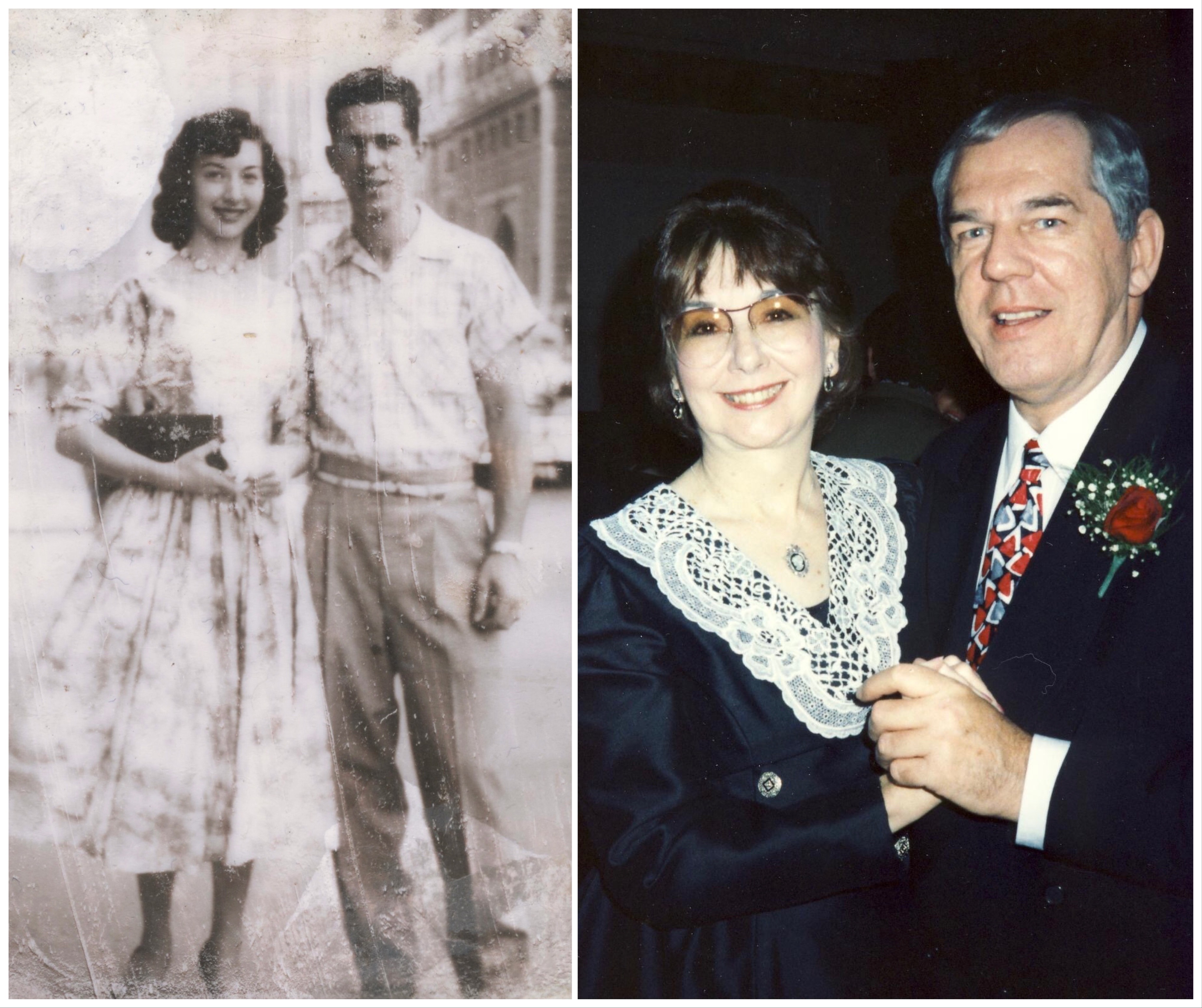


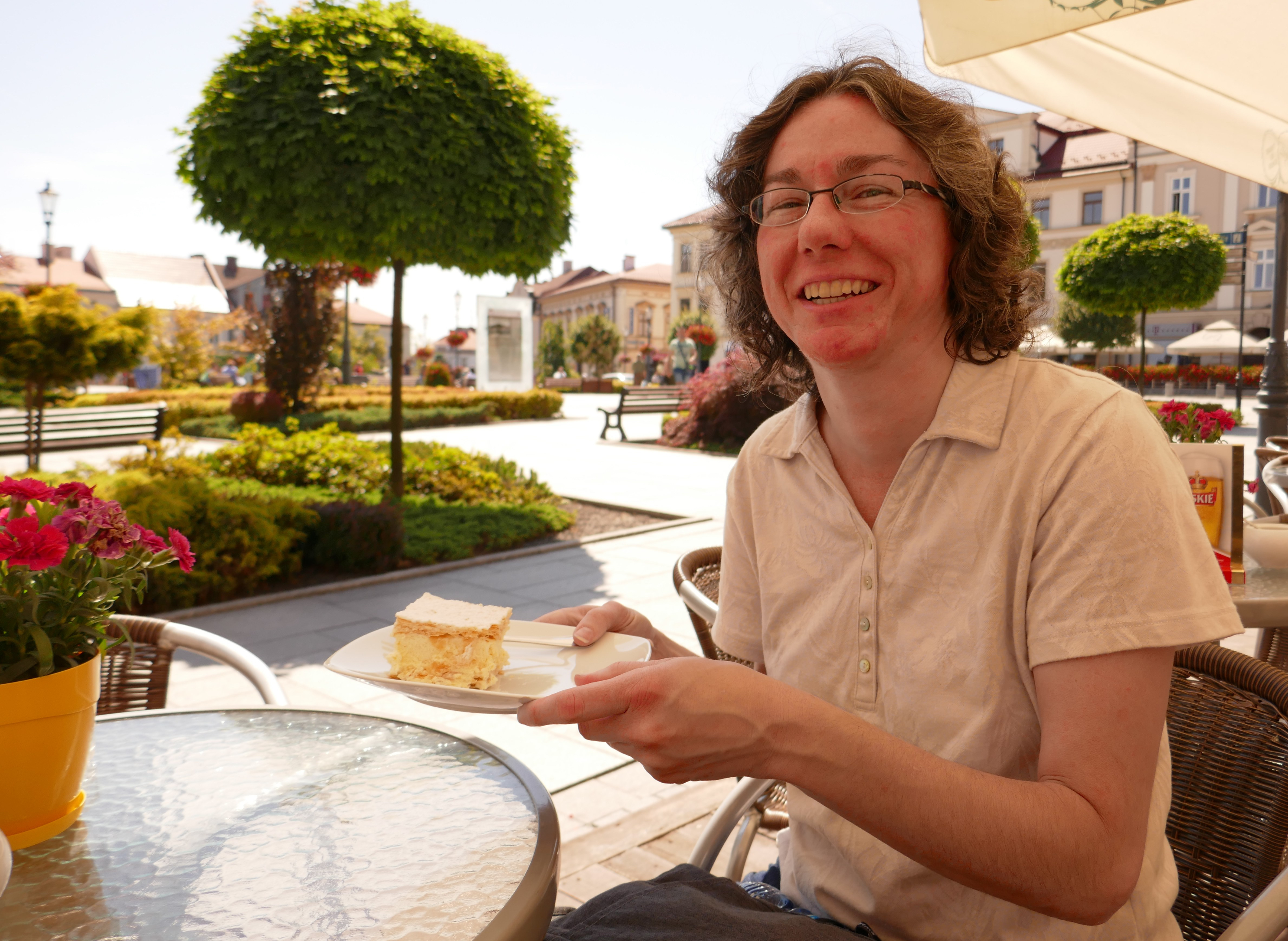


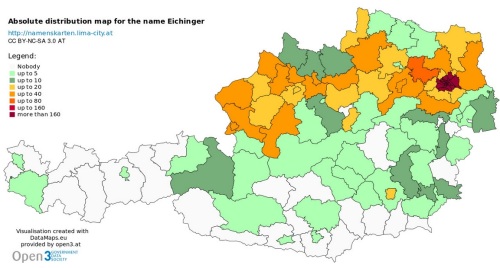
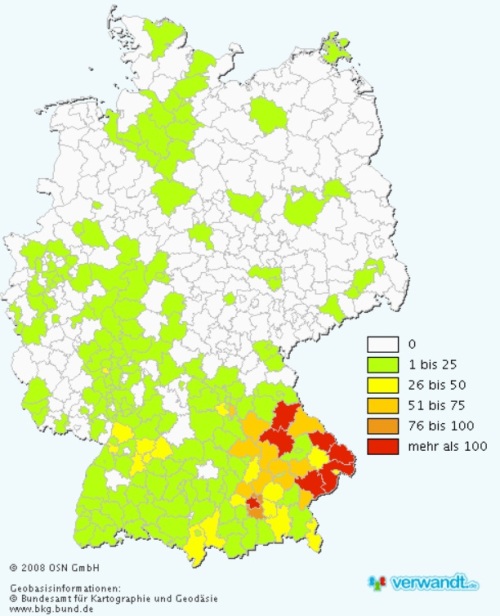
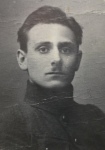

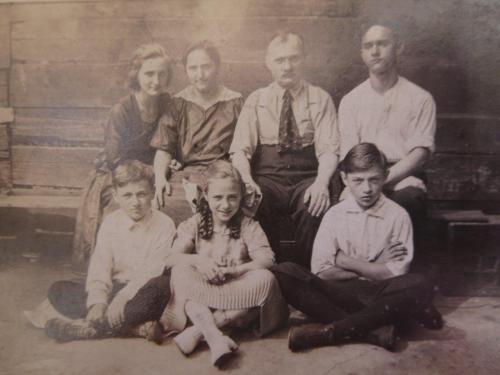
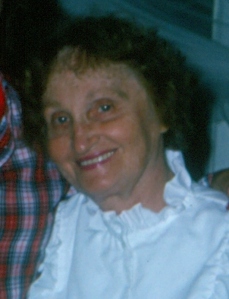




 Jim attended Roman Catholic High School and graduated in 1952. As a teenager and young man, he loved attending neighborhood dances. One night, March 13, 1955, Jim attended a Sunday night
 In the 1970’s, Jim and Anita became active in “show business” at Archbishop Ryan High School (for Boys). The school’s “Mother’s Association” used to put on a show every year, and many of the dads joined in as well. Both performed in dance numbers, but then Jim branched out with his best friend, Frank, into comedy routines. The pair eventually became the comedy directors of the show. One year they performed as Elton John (Jim) and Kiki Dee (Frank) performing “Don’t Go Breaking My Heart”. They were also the Tin Man and Scarecrow in a “Wizard of Oz” skit, and the “Tinettes” — backup dancers for an Ike and Tina Turner rendition of “Proud Mary”. Jim and Frank’s
  Jim was very active in his parish, Our Lady of Calvary. Over the years he served as an usher, a lector, and a Eucharistic Minister. He was among the first class (along with his friend Frank) to complete a ministry training program at St. Charles Seminary. Both men wanted to become permanent deacons, but at the time the parish didn’t have a need for any. Jim and Anita also sang in the choir for many years.
 Jim became a grandfather for the first time in 1995 with the birth of his granddaughter, Natalie. More grandchildren followed: Ava in 2005, Nicholas in 2007, and Luke in 2009.


 What's Past is Prologue